If you are interested in financing to fund your Bay-Lynx purchase, we recommend that you connect with Easylease Corp., a Canadian-based leasing and finance company that offers premier equipment leasing and financial services. They are focused on making it easier than ever before for companies to overcome cash flow and resource constraints to acquire the assets they need to grow their business.
Leasing through Easylease Corp. can offer several benefits:
Click here for your Canadian instant lease quote >>
For US customers, Click here for your instant lease application >>
Choosing the right concrete mixer machine can shape an entire construction project. It affects batching accuracy, labor use, placement speed, and concrete consistency. A mixer is not merely a rotating drum beside a jobsite. It is the point where cement, aggregates, water, and admixtures become one workable material.
The U.S. Geological Survey reported about 91 million metric tons of cement production in the United States in 2023. That volume reflects sustained demand for roads, bridges, housing, and industrial facilities. Market studies from Grand View Research and Research and Markets also identify construction equipment as a growing global sector, driven by urban development and infrastructure renewal. These reports support a practical conclusion: contractors need equipment that performs repeatedly, not occasionally.
Peter C. Taylor, a recognized concrete technology specialist, offers a useful principle: “Concrete quality is built into the process, not rescued at the end.” A concrete mixer machine supports that process by improving proportion control and reducing inconsistent hand mixing. It can also shorten waiting time between batches, especially when trucks, pumps, and crews must work in sequence.
The choice is not automatic.
A poorly sized mixer can waste fuel, space, and materials. An oversized machine may also create unnecessary operating costs. Drum capacity, mobility, discharge height, mixing cycle, maintenance access, and power supply deserve careful comparison. Real jobsites are rarely perfect. Dust enters bearings. Delays happen. Operators make mistakes.
That is why reliable mixer selection combines manufacturer data, operator experience, and project-specific calculations. The strongest decision is practical, measurable, and open to revision.
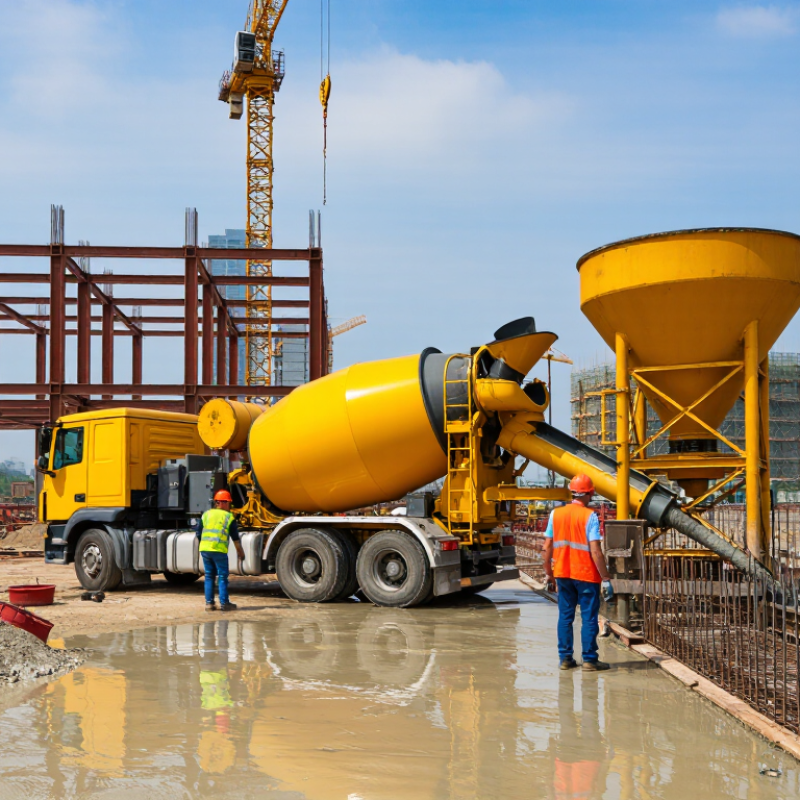
Why Choose a Concrete Mixer Machine for Construction?
Concrete mixer capacity from 0.1 to 10 m³ supports projects of very different sizes. A small 0.1 m³ mixer suits fence posts, drainage repairs, and small residential slabs. It reduces manual mixing and keeps each batch more consistent.
For medium construction work, a 0.5 to 2 m³ machine can supply walkways, columns, and floor sections efficiently. On larger foundations or road projects, models near 10 m³ reduce loading cycles and labor pressure. In practice, the rated capacity is not always the usable capacity. Leave space for safe mixing and material movement.
I have seen crews choose capacity by volume alone, then struggle with narrow access or delayed aggregate delivery. Site conditions matter. Check the mixer’s discharge height, power source, drum speed, and cleaning access before purchase. Moisture changes in sand can also affect the mix, so operators should adjust water carefully and record each batch. Small details matter.
A suitable machine should also provide stable mixing, simple controls, and accessible maintenance points. These features support dependable operation across long workdays. However, larger capacity does not automatically mean higher productivity. If trucks, workers, or formwork cannot keep pace, excess capacity becomes wasted space and energy. Measure the actual pour schedule, not just the project headline.
| Concrete Mixer Capacity | Typical Batch Output | Approximate Output per Hour* | Suitable Project Scale | Common Construction Applications | Key Advantages | Important Selection Considerations |
|---|---|---|---|---|---|---|
| 0.1–0.3 m³ | 0.08–0.25 m³ per batch | 1–4 m³/h | Small-scale and repair work | Maintenance jobs, small slabs, posts, pathways, residential repairs and landscaping | Compact size, easy movement and low material demand | Best where concrete is needed intermittently; loading and cleaning access should be checked |
| 0.35–0.6 m³ | 0.28–0.5 m³ per batch | 3–8 m³/h | Residential and light commercial projects | House foundations, driveways, floor slabs, drainage channels and small retaining walls | Good balance between portability, capacity and operating cost | Confirm available power, aggregate size and required discharge height |
| 0.75–1.0 m³ | 0.6–0.85 m³ per batch | 5–12 m³/h | Medium-scale construction | Residential developments, low-rise buildings, foundations, pavement sections and site concrete | Higher batch volume while remaining suitable for many job-site layouts | Requires a stable working platform and sufficient space for aggregate handling |
| 1.25–2.0 m³ | 1.0–1.7 m³ per batch | 8–20 m³/h | Medium to large construction projects | Commercial buildings, warehouses, bridges, larger foundations and structural concrete work | Reduces batch frequency and supports more consistent concrete placement | Check loading equipment, transport access, power or fuel supply and operator requirements |
| 2.5–4.0 m³ | 2.0–3.4 m³ per batch | 12–30 m³/h | Large job sites and infrastructure work | Industrial floors, road construction, bridge components, large foundations and precast production | Efficient for continuous production and high-volume placement | Needs adequate aggregate storage, material-feeding equipment and traffic management |
| 5.0–7.0 m³ | 4.0–6.0 m³ per batch | 20–45 m³/h | High-volume commercial and civil projects | Large industrial structures, highways, dams, major foundations and infrastructure projects | High production capacity can shorten mixing and placement schedules | Requires engineered foundations, reliable material supply and coordinated concrete placement |
| 8.0–10.0 m³ | 6.5–8.5 m³ per batch | 30–60 m³/h | Major infrastructure and continuous-pour operations | Large bridges, tunnels, dams, airports, power facilities and ready-mix production | Suitable for sustained high-volume output and large-scale concrete demand | Requires substantial site space, high-capacity feeding systems, quality control and coordinated logistics |