If you are interested in financing to fund your Bay-Lynx purchase, we recommend that you connect with Easylease Corp., a Canadian-based leasing and finance company that offers premier equipment leasing and financial services. They are focused on making it easier than ever before for companies to overcome cash flow and resource constraints to acquire the assets they need to grow their business.
Leasing through Easylease Corp. can offer several benefits:
Click here for your Canadian instant lease quote >>
For US customers, Click here for your instant lease application >>
China’s cement mixer truck industry sits at the center of fast urban construction, transport efficiency, and concrete quality control. This guide examines ten leading Chinese manufacturers, rather than simply repeating factory rankings. It considers production scale, drum capacity, chassis options, export experience, after-sales support, and evidence from operating fleets.
Industry data gives useful context. The International Energy Agency’s Cement 2023 report highlights cement’s major energy and carbon challenges. The Global Cement and Concrete Association’s 2050 Roadmap also stresses cleaner production and lower-carbon construction. These pressures affect every cement mixer truck, from fuel consumption at the jobsite to concrete discharge timing. MarketsandMarkets and Research and Markets reports further identify Asia-Pacific as a major region for construction equipment demand. However, market forecasts can differ. They should not replace factory records or customer evidence.
Dr. Karen Scrivener, a leading cement technology expert, has said, “Cement is the most widely used man-made material in the world.” Her point explains why mixer reliability matters. A delayed drum can leave hardened concrete, wasted materials, and a costly repair beside a busy road. The best manufacturers therefore combine robust frames, accurate hydraulic systems, corrosion-resistant drums, and accessible parts. Some also offer electric or low-emission solutions, although real-world performance still requires careful testing. No ranking is perfect. Buyer needs vary by road conditions, climate, payload, and local service capacity. This overview aims to provide a practical starting point for comparing China’s top cement mixer truck manufacturers with clearer, evidence-based expectations.

A cement mixer truck is a mobile concrete plant on wheels.
Its rotating steel drum keeps fresh concrete moving during delivery. Inside, spiral blades fold cement, sand, stone, and water together. This motion slows setting and reduces material separation.
At a job site, hydraulic controls reverse the drum. Concrete then flows through a chute into forms, pumps, or foundations. Experienced operators monitor slump, travel time, and drum speed. Small errors can weaken a pour.
China leads production because its construction market creates steady demand.
Highway, rail, housing, and industrial projects require large concrete fleets. Manufacturers work near dense steel, hydraulic, engine, and electronics supply chains. This proximity shortens procurement routes and supports competitive pricing. Large factories also refine welding, drum balancing, corrosion protection, and automated testing.
Domestic fleets provide practical feedback from crowded cities and demanding construction sites. That experience helps improve designs for hot, cold, dusty, and uneven conditions.
Production volume alone does not guarantee quality.
Reliable buyers inspect frame alignment, drum thickness, load capacity, braking, and water systems. They also review maintenance access and local service support. A truck may look impressive but perform poorly after months of heavy use.
Some low-cost choices create higher repair expenses later. I would not judge a mixer by appearance alone. Field records often reveal more than polished brochures.
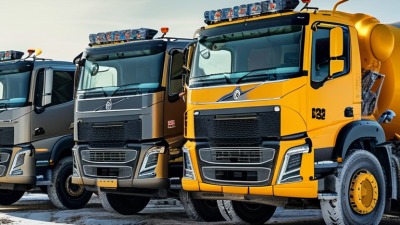
Ranking cement mixer truck manufacturers requires more than comparing advertised prices. I would examine field experience, factory controls, and long-term operating evidence. Drum capacity must match the truck’s chassis and local delivery routes. A larger drum is not always better. It can increase fuel use and axle stress.
Technical performance deserves close inspection. Review mixing uniformity, discharge speed, hydraulic stability, and drum rotation under heavy loads. Check weld quality around the frame and hopper. Operators notice small defects quickly. Reliable manufacturers provide documented load tests, component specifications, and traceable inspection records. Safety features, braking performance, visibility, and emission compliance also affect a credible ranking.
After-sales support can separate a strong supplier from an average one. Evaluate spare-part availability, technician response times, warranty terms, and service coverage near project sites. Ask for maintenance records from comparable fleets, not only polished showroom photographs. Total ownership cost matters, including tires, fuel, downtime, and cleaning labor. Published data may differ from road performance. That gap deserves honest review. No ranking is perfect, especially when regional service quality changes over time. A factory visit, customer interview, and supervised road test can reveal more than a sales presentation.
China’s Top 10 Cement Mixer Truck Manufacturers are best evaluated through evidence, not advertising claims. China’s urbanization rate reached 66.16% in 2023, according to the National Bureau of Statistics. That growth supports steady demand for ready-mix delivery, infrastructure projects, and municipal construction. ResearchAndMarkets’ 2024 Concrete Mixer Trucks—Global Strategic Business Report also identifies Asia-Pacific as a major growth region.
A practical top-ten assessment should examine drum capacity, chassis matching, discharge speed, and after-sales coverage. Field inspections should check weld consistency, hydraulic hose routing, ladder strength, and residual concrete inside the drum. A well-designed truck leaves fewer hardened deposits after washing. That detail matters.
The strongest manufacturers usually offer 8–12 cubic-meter models, automated drum controls, and corrosion-resistant mixing blades. They should also provide parts catalogs, service records, and clear warranty terms. Fuel use deserves attention. A heavy drum can raise operating costs across thousands of delivery cycles. The International Energy Agency’s transport analysis consistently links vehicle efficiency with lower lifecycle energy demand.
However, ranking the top ten is not completely objective. Export volume may hide weak local service, while a smaller producer may provide better customization. Some published market reports combine concrete mixers with broader construction equipment, which can distort comparisons. Buyers should verify production capacity, independent test results, and real fleet feedback before accepting any ranking. Sonic alarms, camera visibility, and stable center-of-gravity design also deserve closer review on crowded urban roads.
China’s top cement mixer truck manufacturers compete on three practical measures: quality, cost, and technology.
In field inspections, frame welds, drum alignment, and hydraulic hose protection deserve close attention. A truck can look polished yet suffer from uneven drum rotation after months of heavy use. That detail matters.
A truck can look polished yet suffer from uneven drum rotation after months of heavy use. That detail matters.
Chinese mixer trucks often offer lower purchase prices than comparable imported units. Their advantage usually comes from large-scale component sourcing and efficient domestic production. However, the invoice is only one part of cost.
Buyers should calculate fuel use, tire wear, service distance, spare-part availability, and driver training. Cheap maintenance can become expensive downtime.
Ask for test records, warranty terms, and parts delivery estimates. Do not rely on a brochure alone.
Technology has improved quickly.
Many current models use automated drum controls, load monitoring, remote diagnostics, and improved emission systems. These features can reduce overloading and help managers track vehicle performance.
Still, electronic functions vary widely between configurations. Software support may also be weaker in remote markets.
I have seen buyers value a large display, then struggle with calibration support. Practical simplicity sometimes wins.
Before choosing among leading suppliers, request a loaded road test, inspect corrosion protection, and compare service response in your operating region. The best option is not always the newest truck.
China Top 10 Cement Mixer Truck Manufacturers?
Buying Considerations for Cement Mixer Trucks from China
Selecting a cement mixer truck from China requires more than comparing purchase prices. Start with the drum capacity, chassis configuration, axle load, and local road limits. A nine-cubic-meter drum may suit large projects, but it can be inefficient on narrow urban roads. Check the mixing speed and discharge time under realistic working conditions. Ask for test records, not only catalog figures.
Material quality deserves close attention. Inspect drum plate thickness, welding points, blade design, and corrosion protection. The hydraulic system should have clearly identified components and accessible service points. Request engine emission documents that match your destination market. Verify vehicle dimensions, braking performance, lighting, and safety equipment before shipment. Small differences can create expensive delays at customs or during registration.
After-sales support often decides the real operating cost. Confirm spare-parts availability, warranty coverage, remote troubleshooting, and technician training. Ask how quickly common seals, hoses, and hydraulic parts can be delivered. A detailed inspection video helps, but it cannot replace an independent pre-shipment inspection. Be cautious with unusually low quotations. They may exclude freight, taxes, tools, or commissioning.
Keep records. Procurement teams sometimes focus too heavily on drum volume and overlook driver visibility or cleaning access. That mistake is easy to make. A practical evaluation should include fuel use, turning radius, maintenance time, and operator feedback. Specifications matter, but daily usability matters more.
Drum capacity is a key selection factor when comparing concrete mixer trucks. The chart shows the approximate mass of fresh concrete at different drum capacities, calculated using an average concrete density of 2.4 tonnes per cubic meter. Actual payload must be checked against the chassis rating, axle-load regulations, road conditions, drum configuration, and local certification requirements.