If you are interested in financing to fund your Bay-Lynx purchase, we recommend that you connect with Easylease Corp., a Canadian-based leasing and finance company that offers premier equipment leasing and financial services. They are focused on making it easier than ever before for companies to overcome cash flow and resource constraints to acquire the assets they need to grow their business.
Leasing through Easylease Corp. can offer several benefits:
Click here for your Canadian instant lease quote >>
For US customers, Click here for your instant lease application >>
Choosing the right cement mixer is rarely a simple capacity comparison. A compact 120-liter drum may suit residential repairs, while a large diesel mixer must survive uneven sites, long shifts, and limited service access. The best choice depends on concrete volume, aggregate size, power supply, transport conditions, and local maintenance support.
Market evidence shows why this equipment matters. The World Bank’s Global Infrastructure Facility and Global Infrastructure Hub have projected nearly USD 94 trillion in infrastructure investment needs through 2040. That demand places pressure on contractors to improve mixing consistency and reduce avoidable delays. The International Energy Agency also reports that cement production creates roughly 7% of global energy-related and process carbon dioxide emissions. Efficient batching cannot solve that problem alone, but accurate mixing can reduce rejected loads, material waste, and repeated work.
This guide examines 10 best cement mixer options for global buyers. It compares drum design, mixing output, motor type, fuel consumption, controls, mobility, safety features, and spare-parts availability. Product data will be considered alongside practical site concerns, including voltage differences and harsh weather. Small details matter.
A mixer that looks powerful on paper may disappoint in muddy conditions. Conversely, a basic electric model may outperform expensive equipment on a stable indoor project. No universal winner exists. That is the uncomfortable part. Buyers should verify manufacturer specifications, independent test evidence, warranty terms, and regional service capability before ordering. Reports from Grand View Research and Fortune Business Insights indicate continued construction-equipment demand, but market forecasts cannot replace hands-on evaluation. This shortlist aims to make that evaluation clearer, not pretend that every jobsite follows the brochure.
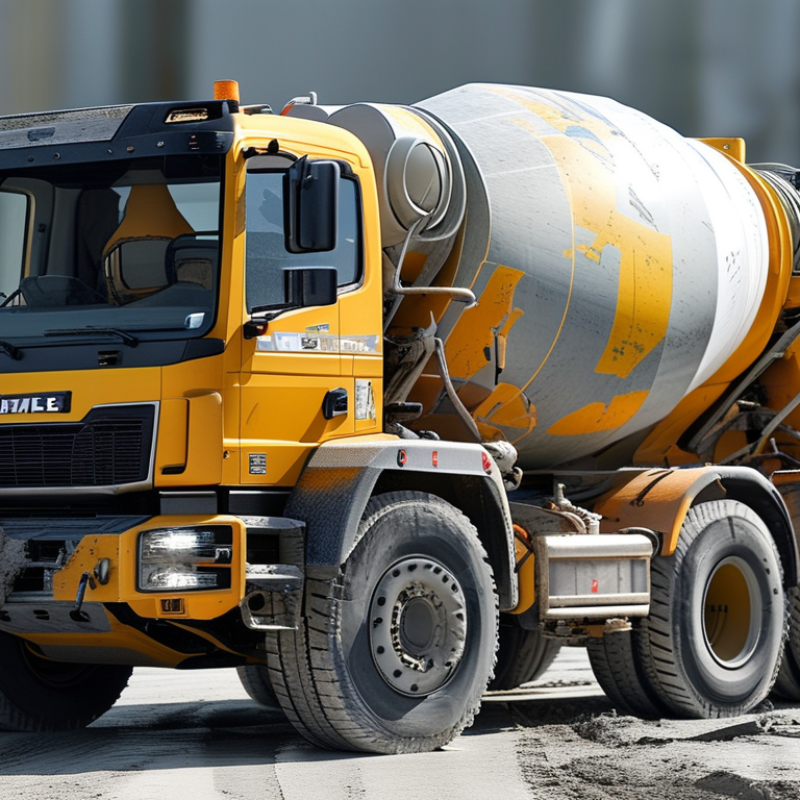
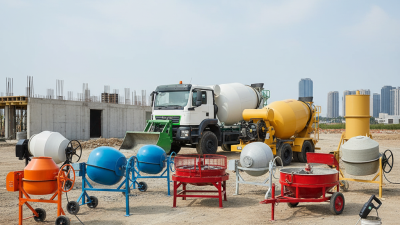
Cement mixer selection begins with the mixing principle, not the price tag. Drum mixers rotate a tilted vessel, lifting materials with internal fins. They suit concrete batches with aggregates and moderate output. Pan mixers use a fixed bowl and rotating blades. They usually provide faster, more uniform mixing for mortar, precast products, and dry blends. Twin-shaft mixers deliver intense, continuous agitation for large production lines.
Core components include the drum or pan, blades, gearbox, motor, frame, discharge system, and safety guard. Electric motors work well where stable power exists. Diesel systems offer mobility, but they require ventilation and stricter maintenance. The operating cycle is simple: load measured materials, mix for the specified time, then discharge completely. Water changes workability, not just strength. Too much water can weaken the finished concrete.
The International Energy Agency reported that cement production creates about 7% of global carbon dioxide emissions. The Global Cement and Concrete Association describes concrete as the world’s most widely used manufactured material, with roughly 14 billion cubic metres produced annually. These figures make efficient batching important.
Tips: Check blade wear, drum thickness, emergency stops, and spare-part access. Match capacity to real batch size, not advertised maximum volume. A mixer running half-empty may waste energy. A small calibration error can repeat across thousands of batches. Recheck water dosing. Human judgment still matters.
A practical comparison of common cement mixer types, typical specifications, essential components, and operating principles for international construction applications.
| No. | Mixer Type | Typical Mixing Capacity | Approx. Output per Hour | Typical Drive Power | Main Components | Operating Principle | Best-Fit Applications |
|---|---|---|---|---|---|---|---|
| 1 | Twin-Shaft Concrete Mixer | 1.0–6.0 m³ per batch | 30–180 m³/h | 2 × 18.5–2 × 75 kW | Two horizontal shafts, mixing paddles, heavy-duty trough, discharge gate, gear reducers, and electric motors. | Two counter-rotating shafts create intense shearing, folding, and lifting action. Materials are rapidly blended across the full width of the trough. | Ready-mix plants, precast concrete, infrastructure projects, and mixes requiring high uniformity. |
| 2 | Planetary Concrete Mixer | 0.25–4.0 m³ per batch | 10–120 m³/h | 7.5–110 kW | Vertical mixing pan, rotating planetary arms, mixing tools, scrapers, hydraulic or pneumatic discharge gate, and drive unit. | Mixing tools rotate around their own axes while orbiting the central shaft, producing multidirectional movement and effective dispersion. | Precast products, colored concrete, dry mortar, fiber-reinforced concrete, and specialty formulations. |
| 3 | Pan Mixer | 0.1–1.5 m³ per batch | 3–45 m³/h | 3–30 kW | Circular mixing pan, vertical shaft, paddles or blades, adjustable scraper arms, discharge door, and motor. | A vertical shaft rotates paddles through a stationary pan. Scrapers continuously return material from the wall toward the active mixing zone. | Small precast facilities, pavers, blocks, curbs, repair concrete, and construction sites with moderate output requirements. |
| 4 | Horizontal Single-Shaft Mixer | 0.5–4.0 m³ per batch | 15–120 m³/h | 11–90 kW | Horizontal mixing chamber, single shaft, paddles or blades, end bearings, discharge gate, gearbox, and drive motor. | A rotating shaft moves materials through a horizontal chamber by lifting, dropping, and folding the mixture toward the outlet. | General ready-mix production, concrete products, mortar, and applications needing a relatively simple mixer layout. |
| 5 | Drum Concrete Mixer | 0.15–9.0 m³ per batch | 5–90 m³/h | 5.5–75 kW | Rotating steel drum, internal blades, support rollers, ring gear or friction drive, charging hopper, and discharge mechanism. | Internal blades lift the ingredients as the drum rotates, allowing the material to cascade and blend by gravity and repeated tumbling. | Mobile batching operations, general building work, rural projects, and sites where straightforward operation is important. |
| 6 | Reversible Drum Mixer | 0.25–1.5 m³ per batch | 6–40 m³/h | 7.5–30 kW | Reversible rotating drum, lifting blades, gear drive, electric motor, charging hopper, and two-direction discharge assembly. | The drum rotates in one direction for mixing and reverses direction to move the finished concrete toward the discharge opening. | Small and medium construction sites, road repairs, foundations, and projects requiring controlled discharge without tilting the drum. |
| 7 | Self-Loading Mobile Mixer | 1.0–5.5 m³ per batch | 10–60 m³/h | 45–130 kW | Rotating drum, front loading bucket, chassis, articulated steering, water tank, weighing system, hydraulic circuit, and discharge chute. | The machine loads, weighs, mixes, transports, and discharges ingredients using a rotating drum and integrated hydraulic systems. | Remote sites, utility construction, agricultural projects, roadwork, and locations without a permanent batching plant. |
| 8 | Continuous Twin-Shaft Mixer | 15–300 t/h feed rate | 10–200 m³/h | 2 × 15–2 × 90 kW | Twin shafts, paddles, continuous feed inlet, water and additive dosing points, mixing chamber, and adjustable outlet gate. | Aggregates, cement, water, and additives enter continuously while synchronized shafts transport and homogenize the material toward the outlet. | Roller-compacted concrete, soil stabilization, cement-treated base, mine backfill, and large-volume continuous production. |
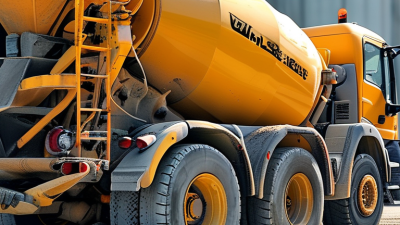
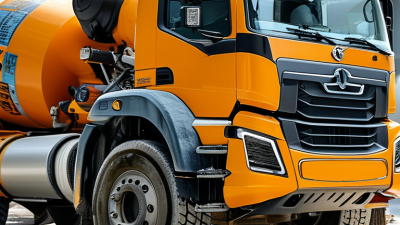
| 9 | Truck-Mounted Transit Mixer | 4–12 m³ per load | Dependent on delivery cycle | Chassis PTO-driven | Mounted mixing drum, spiral blades, subframe, water system, hydraulic motor, discharge chute, and truck chassis. | A helical blade inside the drum keeps concrete agitated during transport. Reversing the drum rotation moves the concrete toward the discharge chute. | Urban construction, long-distance delivery, high-rise projects, bridge work, and centralized ready-mix distribution. |
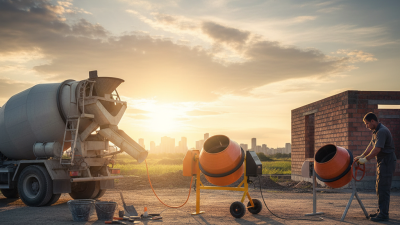
| 10 | Small Portable Electric Mixer | 0.05–0.25 m³ per batch | 1–8 m³/h | 0.5–3 kW | Compact drum, internal mixing blades, electric motor, reduction gearbox, tipping frame, wheels, and manual discharge handle. | A low-power motor rotates the drum while fixed blades lift and tumble the materials to produce small batches of concrete or mortar. | DIY work, maintenance, landscaping, small foundations, masonry, and locations with single-phase electrical supply. |
Note: Capacities, output rates, and power requirements are typical industry ranges. Actual performance depends on mix design, aggregate size, moisture content, loading efficiency, operating cycle, and local electrical or vehicle standards.