
Financing

If you are interested in financing to fund your Bay-Lynx purchase, we recommend that you connect with Easylease Corp., a Canadian-based leasing and finance company that offers premier equipment leasing and financial services. They are focused on making it easier than ever before for companies to overcome cash flow and resource constraints to acquire the assets they need to grow their business.

Leasing through Easylease Corp. can offer several benefits:

  • Conserve Cash Leasing
  • 100% Financing
  • No Pre-Payment of Taxes
  • Preserve Lines of Credit
  • Potential Income Tax Benefits
  • Pay as You Profit
  • Match Revenue with Expenditures
  • Simple, Convenient Process
  • Tailored Payments

Click here for your Canadian instant lease quote >>

For US customers, Click here for your instant lease application >>

Why Choose a Golf Cart Seat for Global Buyers?

Choosing a Golf Cart Seat is more than selecting a soft cushion for a recreational vehicle. Global buyers often need comfort, durability, weather resistance, and dependable fit in one product. A seat may look attractive online, yet its real performance depends on foam density, marine-grade vinyl, stitching, frame strength, and mounting accuracy. Comfort matters.

In practical sourcing work, buyers should compare seat dimensions, weight limits, installation drawings, and replacement-part availability. Seats used near beaches face salt air, while golf courses may expose upholstery to rain, dust, and strong sunlight. These conditions demand different material choices. A reputable supplier should provide clear specifications, inspection records, product photos, and responsive technical support. Independent testing can also help confirm stability, abrasion resistance, and color retention.

There is no universal best option. That assumption is not always right. A premium seat can still fail when its brackets do not match the cart model. Buyers should confirm the vehicle year, model, rear-seat configuration, and intended use before ordering. Packaging quality matters too, especially during long-distance shipping. Crushed corners or stretched upholstery can turn a good product into a costly problem. Measure twice.

Reliable purchasing also requires honest communication about lead times, customization limits, maintenance needs, and warranty coverage. Some sellers promise extensive service but offer little evidence. Careful buyers should question those claims. With thoughtful comparison and realistic expectations, a Golf Cart Seat can improve passenger comfort, support safer operation, and deliver value across different markets. It may not solve every ride-quality issue, but it is an important part of the overall experience.
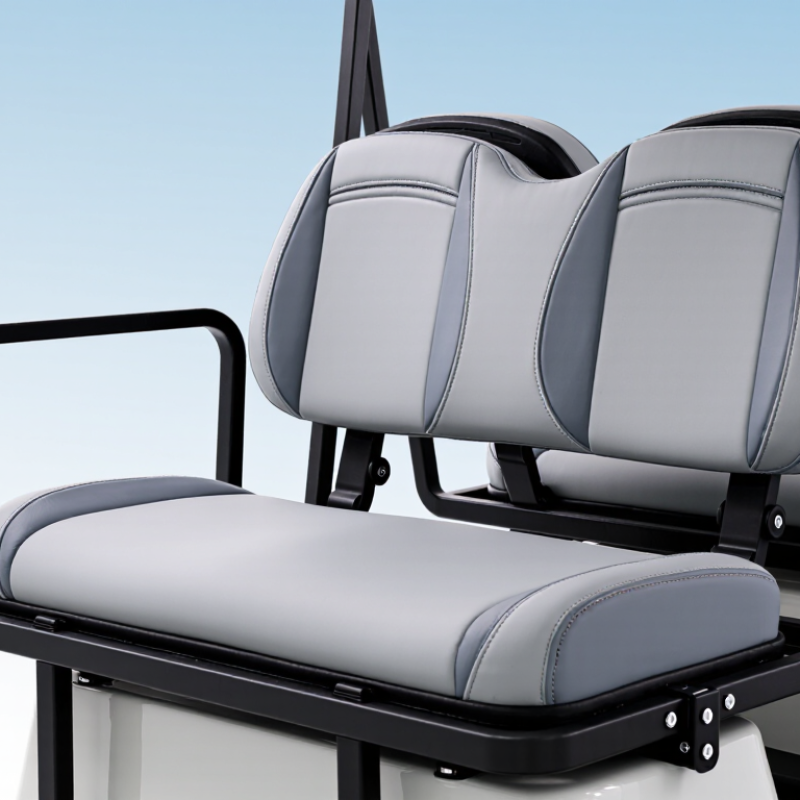
Why Choose a Golf Cart Seat for Global Buyers?

Golf Cart Seat Types: Bench, Bucket, and Flip-Fold Designs

Choosing a golf cart seat requires more than comparing colors and prices. Global buyers should match the design with passenger needs, road conditions, and maintenance habits. Bench seats offer a continuous cushion for families, short transfers, and casual use. They allow passengers to move slightly, but this flexibility can reduce individual support. Their broad surface may also collect rainwater if drainage is poor.

Bucket seats provide separate seating positions and stronger lateral support. They feel more stable during turns, especially on uneven paths. Each passenger gets a defined backrest and sitting area. That comfort suits longer rides and frequent daily use. However, bucket seats usually take more space and may limit carrying capacity. They can also require more careful fitting during installation.

Flip-fold seats combine passenger seating with practical cargo space. Fold the backrest, and the rear area can carry tools, parcels, or outdoor equipment. This design helps users whose needs change throughout the day. Hinges, locking points, and cushion seams deserve close inspection. Small hardware failures become inconvenient quickly. In field checks, I look for firm frames, smooth folding action, and water-resistant upholstery. Materials should tolerate sunlight, dust, and repeated cleaning. No design wins every route. A bench may be ideal for group transport but awkward for longer journeys. A flip-fold model may be versatile yet less comfortable for extended sitting. Buyers should measure the cart, confirm mounting points, and consider local weather before choosing.

Capacity Matching: 2-, 4-, and 6-Passenger Cart Configurations

Global golf demand makes seating capacity a practical purchasing decision. The R&A’s Golf Around the World 2023 report counted 66.6 million golfers across 206 countries. The National Golf Foundation also recorded about 531 million golf rounds in the United States during 2023. These figures suggest varied transport needs, from private course travel to resort shuttles and community mobility.

A two-passenger cart suits narrow paths, maintenance teams, and couples carrying small bags. Its shorter body can improve turning control around storage areas. A four-passenger configuration is often the most flexible choice. It carries two adults, two children, or moderate equipment without excessive length. Check the payload rating carefully. Four seats do not mean four heavy adults plus luggage.

Six-passenger carts support resorts, events, campuses, and larger families. They need wider turning space, stronger braking, and suitable ground clearance. The R&A’s participation data supports high-volume recreation, but it does not prove that every buyer needs six seats. That assumption deserves review. A six-seat model may reduce trip frequency, yet increase energy use and parking demands. Climate, slope, road surface, passenger weight, and local operating rules should shape the final match. The safest capacity decision combines seating count with real daily load.

Safety Benchmark: FMVSS 500 Limits LSVs to 25 mph and 3,000 lb GVWR

For global buyers, a golf cart seat is more than a cushion. It affects posture, passenger stability, and safe entry. In practical inspections, I check the seat frame, mounting points, belt compatibility, and cushion grip. A soft seat feels comfortable, but excessive movement can become a safety concern.

FMVSS 500 defines important limits for low-speed vehicles in the United States. An LSV is generally designed for speeds above 20 mph but not above 25 mph. Its gross vehicle weight rating must remain below 3,000 pounds. These limits influence the vehicle’s structure, braking performance, lighting, mirrors, windshield, and occupant protection equipment. The rule does not certify a replacement seat by itself. Buyers should verify the complete vehicle configuration.

A suitable seat should fit the original mounting pattern without forcing new holes or weakening the frame. Check whether the backrest supports two passengers evenly. Inspect the belt anchor area, especially after repeated loading on uneven ground. Small details matter. A loose hinge does too. Local road rules may differ from United States requirements, so importers should confirm approval, labeling, and inspection needs in the destination market. I would not treat a manufacturer’s speed claim as proof of compliance. Independent measurements, installation records, and clear technical documents provide stronger evidence. Mistakes happen when comfort is judged before structure. Safety deserves the opposite order.

Material Compliance: FMVSS 302 Sets a 4-in/min Interior Burn-Rate Limit

Why Choose a Golf Cart Seat for Global Buyers?

For global buyers, a golf cart seat is more than a comfort feature. Its materials can influence safety, durability, and market acceptance. FMVSS 302 limits the horizontal burning rate of specified vehicle interior materials to 4 inches per minute. This requirement is measured under controlled laboratory conditions. It can apply to materials such as seat covers, foam, and related interior components.

A compliant seat should be evaluated as a complete construction. Check the cover fabric, foam layer, thread, adhesive, and backing material. One fast-burning layer may affect the entire result. Ask for a current test report from a qualified laboratory. The report should identify the tested material, thickness, production batch, and test method. Clear traceability matters when seats are supplied across different countries.

A certificate alone can mislead. Materials may change after testing. Colorants, coatings, recycled fibers, or replacement foam can alter performance. I would compare the approved sample with the actual production seat. Small details matter, including exposed foam near stitching and heat from nearby equipment. FMVSS 302 is a United States requirement, not a universal global law. Buyers should still confirm local rules and customer specifications before ordering. That extra review feels slow, but it can prevent costly rework.

Why Choose a Golf Cart Seat for Global Buyers? - Material Compliance: FMVSS 302 Sets a 4 in/min Interior Burn-Rate Limit

Compliance Dimension Verified Requirement or Reference Technical Data Why It Matters to Global Buyers
Primary flammability reference Federal Motor Vehicle Safety Standard No. 302, codified at 49 CFR § 571.302 Interior materials flammability performance Provides a recognized benchmark when evaluating seat upholstery, foam coverings, and other occupant-compartment materials.
Maximum burn rate The material must not burn or transmit flame at a rate exceeding the specified limit after ignition under the test procedure. 4 inches per minute maximum
Equivalent to 101.6 mm/minute
A measurable limit helps buyers compare material constructions and reduce fire-propagation risk inside the seating area.
Typical test specimen FMVSS 302 uses a horizontal burning test on a representative material specimen. Approximately 356 mm × 100 mm
Approximately 14 in × 4 in
Testing should represent the actual seat material stack rather than relying only on a fabric or foam component tested separately.
Ignition exposure The standard specifies exposure to a small gas flame before the specimen is observed for burning behavior. Flame exposure: approximately 15 seconds A controlled ignition period supports repeatable comparison between different upholstery and cushioning constructions.
Materials to evaluate Seat coverings, cushioning materials, backing layers, thread, bonded laminates, and exposed trim may affect the final assembly result. Evaluate the complete material combination used in production. A compliant cover may not provide the same performance when paired with a different foam, adhesive, backing, or sewing construction.
Documentation for purchasing Request a test report or supplier declaration that identifies the tested material, construction, date, method, and result. Recommended records: material specification, test report, revision number, and batch or lot traceability. Clear records simplify import reviews, customer audits, product updates, and quality investigations.
Global-market consideration FMVSS 302 is a United States motor-vehicle safety standard; its legal applicability depends on the vehicle classification and intended use. Confirm destination-market requirements before placing an order. Using the 4 in/min benchmark can support consistent sourcing, but it should not be treated as automatic certification for every golf cart or country.
Buyer selection checklist Prioritize documented flammability performance, consistent material construction, weather resistance, dimensional fit, and replacement availability. Compare complete seat assemblies, not upholstery fabric alone. A documented and repeatable seat specification reduces compliance uncertainty and supports long-term fleet maintenance.

Reference note: FMVSS No. 302 establishes a horizontal-burn performance requirement for specified motor-vehicle interior materials. Confirm current regulatory applicability, test scope, and destination-market obligations with the responsible compliance authority before commercial use.

Global Purchasing: Compare Fit, UV Resistance, Warranty, and Parts Supply

For global buyers, a golf cart seat should fit the vehicle before it looks attractive. Measure the seat pan, mounting holes, hinge position, and backrest angle. Small differences can create loose bolts or uneven support. I have seen replacement seats fit the cushion but miss the original brackets. That mistake adds shipping costs and installation time.

UV resistance deserves close attention in sunny regions. Look for marine-grade vinyl, dense foam, and reinforced stitching. Ask how the material performs after prolonged outdoor exposure, not just after laboratory testing. Dark covers may become hot, while light covers can show dirt quickly. Neither choice is perfect. Warranty terms should identify coverage length, excluded damage, and the process for claiming support. Vague wording creates uncertainty.

Parts supply can matter more than the initial price. Confirm whether covers, hinges, brackets, cushions, and fasteners can be ordered separately. Request a parts diagram and stable product codes before purchasing. Regional warehouses may shorten delivery, but availability should be confirmed in writing. Packaging also matters; crushed corners can appear after a long journey. My purchasing checklist now includes photos, measurements, material details, and response times from the supplier. I still allow room for mistakes, because vehicle measurements are sometimes incomplete or poorly recorded.