
If you are interested in financing to fund your Bay-Lynx purchase, we recommend that you connect with Easylease Corp., a Canadian-based leasing and finance company that offers premier equipment leasing and financial services. They are focused on making it easier than ever before for companies to overcome cash flow and resource constraints to acquire the assets they need to grow their business.
Leasing through Easylease Corp. can offer several benefits:
Click here for your Canadian instant lease quote >>
For US customers, Click here for your instant lease application >>
China has become a major source of professional Plumber Tools for distributors, contractors, and maintenance teams worldwide. Its manufacturing base includes established factories, specialist workshops, and OEM suppliers with different strengths. Some focus on pipe wrenches and cutters. Others produce press tools, drain equipment, inspection devices, or complete plumbing tool sets.
Identifying the top manufacturers requires more than comparing catalog size or factory photographs. A reliable review should examine material quality, machining accuracy, heat treatment, handle comfort, and production consistency. It should also consider ISO systems, product testing, warranty practices, and export experience. For example, a durable pipe wrench should grip firmly without excessive jaw movement. A professional cutter should create a clean edge after repeated use, not only during a showroom demonstration.
Supplier communication matters too. Clear drawings, sample approval, traceable batches, and responsive after-sales service reduce purchasing risks. Experienced buyers often request inspection reports and test samples before placing larger orders. That step can reveal weaknesses that marketing language hides.
There is no single manufacturer that suits every buyer. A contractor may value rugged tools and quick replacement parts. A distributor may prioritize packaging, private labeling, and stable container production. Rankings can also change as factories expand, replace equipment, or lose key technical staff. That uncertainty deserves attention.
This guide examines China’s leading plumber tool manufacturers through practical and professional criteria. It aims to separate proven capability from polished claims, while recognizing that even respected suppliers may have limitations. Real performance depends on the tool, the application, and the supplier relationship.
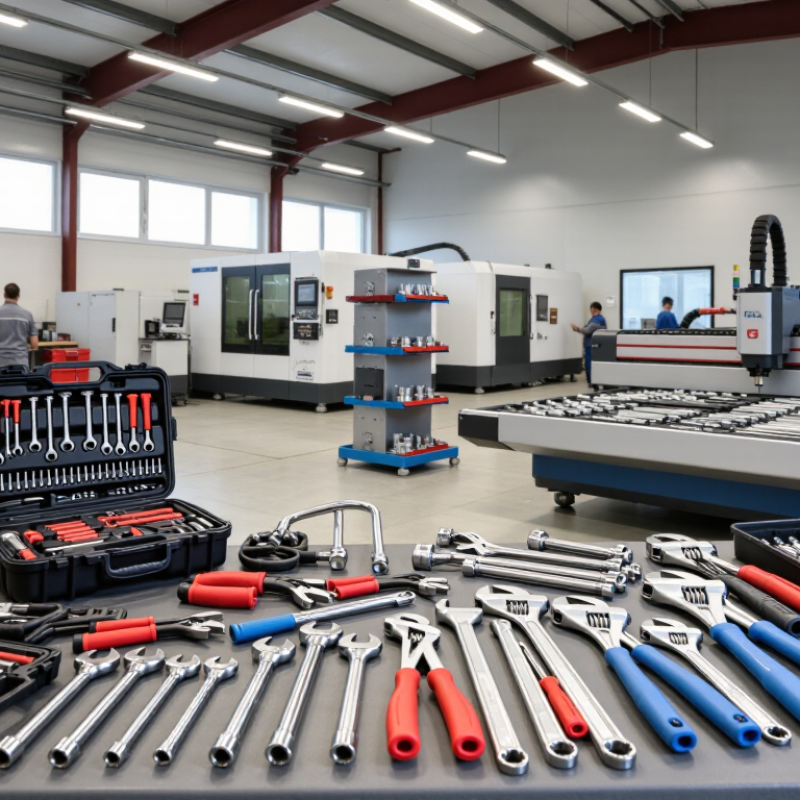
A top Chinese plumbing tools manufacturer is defined by measurable performance, not factory size alone. Grand View Research values the global hand tools market at over USD 20 billion and expects continued growth through 2030. This demand raises the standard for Chinese suppliers. Buyers should examine hardness consistency, jaw alignment, torque performance, corrosion resistance, and batch traceability. A polished sample means little if production varies.
Quality systems provide stronger evidence. ISO 9001 certification supports process control, but it does not guarantee excellent tools. Independent testing should verify relevant requirements under ISO, EN, or ASME standards. For insulated tools, electrical safety testing is essential. For pipe wrenches and cutters, load tests should reflect real workshop pressure. TÜV Rheinland and Intertek reports can help confirm laboratory results, though buyers should check sample identification carefully.
Export reliability is another key metric. UN Comtrade trade data places China among the leading exporters of hand tools under HS 8204 and HS 8205. However, export volume can hide weak after-sales service. Ask for defect rates, warranty claims, inspection records, and on-time delivery data. A supplier reporting less than 1% defects sounds impressive, but the calculation may exclude returns. That deserves questioning. Factory visits also reveal practical details: organized dies, calibrated gauges, protected storage, and workers who can explain testing procedures. The best manufacturer combines stable production, transparent evidence, and tools that remain dependable after repeated use.
The following table summarizes practical, verifiable screening metrics for evaluating Chinese plumbing-tools manufacturers. The numerical values are procurement benchmarks or commonly used qualification targets, not claims about any individual company or brand.
| Evaluation Dimension | Key Metric | Recommended Benchmark or Requirement | Why It Matters | Verification Evidence |
|---|---|---|---|---|
| Quality Management | Quality-system certification | ISO 9001:2015 with a valid certificate covering the relevant manufacturing scope | Shows that production, inspection, corrective action, and document-control procedures are formally managed. | Certificate number, issuing body, scope, validity period, and on-site audit records |
| Product Compliance | Applicable tool standards | Product-specific conformity with recognized standards such as ASME B107 series, ISO 6789 for torque tools, EN 60900 or ASTM F1505 for insulated tools, where applicable | Confirms that performance and safety requirements are defined against recognized technical criteria. | Test reports showing the exact model, test method, sample quantity, and test date |
| Manufacturing Capability | Process control | Documented control of forging, machining, heat treatment, grinding, plating, assembly, and final inspection | Plumbing tools depend on dimensional accuracy, strength, surface finish, and reliable jaw or handle performance. | Process flow chart, control plan, equipment list, and production-line audit |
| Material Quality | Material traceability | Traceable steel or alloy certificates for each production batch; commonly used materials may include carbon steel, alloy steel, or chrome-vanadium steel depending on the tool | Material chemistry and heat-treatment history directly affect hardness, toughness, wear resistance, and breakage risk. | Mill test certificates, batch codes, incoming inspection reports, and heat-treatment records |
| Mechanical Performance | Load, torque, and hardness testing | Testing defined by the applicable product standard, with recorded acceptance limits for jaws, handles, drive components, and adjustable mechanisms | Ensures that tools withstand practical operating loads without excessive deformation or premature failure. | Calibration-controlled test equipment, laboratory records, and model-specific test reports |
| Dimensional Consistency | Critical dimension control | Inspection of jaw opening, tooth profile, handle dimensions, drive size, thread engagement, and other functional dimensions using calibrated gauges | Consistent dimensions improve fit, grip, interchangeability, and user safety. | Inspection standards, gauge calibration certificates, first-article reports, and sampling plans |
| Defect Prevention | Final product quality target | Buyer-defined AQL and acceptance criteria; many professional procurement programs use a tightened target near 1.0% or lower for major defects | AQL is a sampling framework, not a guarantee of zero defects. Clear defect classification reduces disputes during shipment inspection. | Approved inspection standard, defect photographs, inspection reports, and corrective-action records |
| Production Capacity | Capacity and scalability | Documented monthly capacity for the specific tool category, with reserved production slots during peak seasons | A capable manufacturer should maintain stable supply when order volume, packaging requirements, or product range increases. | Capacity statement, equipment schedule, staffing plan, and production records with sensitive information removed |
| Delivery Reliability | On-time delivery performance | Procurement benchmark of approximately 95% or higher against confirmed production and shipment dates | Reliable delivery supports distributor inventory planning and reduces stockout risk. | Rolling 6–12 month delivery-performance report, purchase-order history, and shipment documentation |
| Product Development | Engineering and tooling support | Ability to provide drawings, samples, 2D/3D files, design-for-manufacturing feedback, and controlled tooling changes | Strong engineering support shortens development cycles and improves private-label or application-specific products. | Sample-development records, engineering-change notices, drawings, and prototype approval documents |
| Testing Resources | Laboratory competence | In-house or qualified external testing for hardness, torque, load, coating adhesion, corrosion resistance, and dimensional accuracy | Reliable testing helps detect process variation before products reach customers. | Equipment calibration records, test-method documents, and ISO/IEC 17025-accredited reports when external laboratories are used |
| Surface Protection | Corrosion and finish control | Defined coating or plating specification, surface-preparation procedure, and corrosion test method appropriate to the product and market | Rust resistance and consistent finish affect tool service life, appearance, and customer acceptance. | Coating specification, thickness records, adhesion results, salt-spray reports where contractually required, and visual standards |
| Packaging and Export Readiness | Packaging performance | Packaging tested for abrasion, moisture, compression, handling, barcode accuracy, and carton-drop risks during international transport | Proper packaging protects tools and reduces damage, labeling errors, and customs or warehouse issues. | Packaging specification, carton marks, packing-list samples, drop-test records, and export documentation |
| Environmental and Social Compliance | Responsible manufacturing controls | Documented controls for restricted substances, wastewater, waste handling, worker safety, and applicable customer code-of-conduct requirements | Compliance reduces regulatory, reputational, and supply-chain risks for international buyers. | Environmental permits, restricted-substance declarations, safety records, and independent audit reports |
| Commercial Capability | Total cost and order flexibility | Transparent quotation covering tooling, packaging, testing, logistics assumptions, minimum order quantity, lead time, and payment terms | The lowest unit price does not always provide the lowest total landed cost or the best supply reliability. | Itemized quotation, landed-cost model, approved sample, and written commercial terms |
| After-Sales Support | Complaint and corrective-action response | Formal process for complaint registration, root-cause analysis, containment, corrective action, and response-time commitments | Fast and evidence-based resolution protects the buyer from repeated quality problems. | Corrective-action template, response-time policy, warranty terms, and anonymized case records |
Assessment note: A top manufacturer should be evaluated through a combination of certification review, sample testing, factory auditing, production inspection, delivery history, and total-cost analysis. Certification alone does not prove product performance or long-term supply reliability.
