What Is a High Flow Filter Cartridge?
High Flow Filter Cartridges are designed to move large fluid volumes through compact filtration equipment. They support demanding processes in water treatment, food production, pharmaceuticals, chemicals, and industrial manufacturing. Unlike standard cartridges, they often provide greater flow capacity, longer service intervals, and reduced housing requirements.
Warren L. McCabe, a respected chemical engineering author, described filtration as “the separation of solids from a suspension in a liquid by causing the liquid to pass through a porous medium.” This definition remains useful. However, modern High Flow Filter Cartridges involve more than separating particles. Their performance depends on media structure, pleat design, seal quality, pressure drop, and chemical compatibility. Small details matter. A poorly matched cartridge may clog early, even when its advertised flow rate appears impressive.
In practice, operators inspect the fluid first. They consider particle size, viscosity, temperature, and contamination load. They also check whether the cartridge must meet specific sanitary or process standards. A large cartridge is not automatically a better cartridge. That assumption deserves careful review. Real performance may change when water contains fine silt, oil, microbes, or irregular solids. This guide explains how high flow cartridges work, where they are used, and how to evaluate their specifications. It also addresses common selection mistakes, because published numbers do not always reflect actual operating conditions. Experience at the installation site still matters. The filter must protect the process reliably, not merely look efficient on paper.
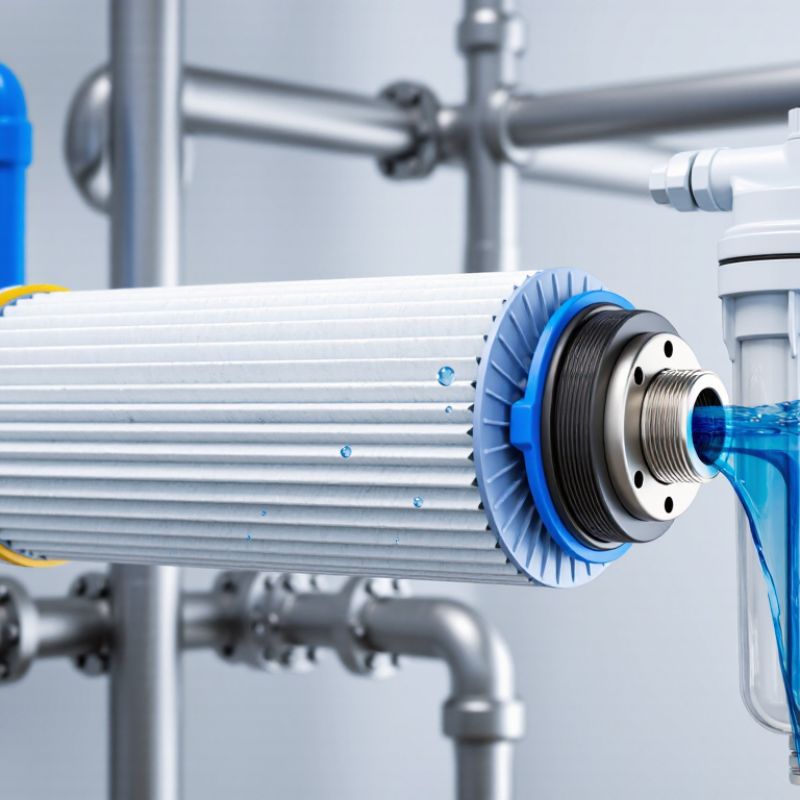
Defining High-Flow Filter Cartridges: 500–1,000 GPM per Element
What Is a High Flow Filter Cartridge?
Defining High-Flow Filter Cartridges: 500–1,000 GPM per Element
A high-flow filter cartridge is designed to process large water volumes through one compact element. In many industrial systems, one cartridge handles approximately 500–1,000 gallons per minute. That equals about 1,893–3,785 liters per minute. The actual rate depends on media type, micron rating, temperature, and pressure loss.
This range is a design reference, not a guaranteed operating result. A 1-micron cartridge usually creates more resistance than a 20-micron cartridge. Dirty water also reduces flow quickly. Field experience shows that a higher advertised capacity may require lower loading, better pretreatment, or more frequent replacement. The U.S. EPA’s 2023 Drinking Water Infrastructure Needs Survey estimated $625 billion in investment needs over 20 years. That pressure encourages compact filtration, but capacity claims still need careful verification. Ask for clean-pressure-drop curves, tested flow conditions, and contaminant-loading data.
Tips: Size the housing for the worst expected flow, not the average. Check whether the rating uses water at room temperature. Confirm the cartridge’s dirt-holding capacity before reducing element count. Leave practical space for removal and inspection. A small error here becomes expensive during peak demand. Also, do not treat 1,000 GPM as a universal target; real performance can fall sharply when solids, viscosity, or temperature changes. Recheck the calculation with site data before installation.
How Pleated Media Delivers 4–6× More Flow per Housing
What Is a High Flow Filter Cartridge?
How Pleated Media Delivers 4–6× More Flow per Housing
A high flow filter cartridge uses deep pleats to create more filtration area inside one housing. More area usually means lower pressure drop at the same flow rate. In practical terms, one cartridge may replace four to six conventional cartridges, depending on media, fluid viscosity, and dirt loading. The 4–6× figure is a design range, not a universal guarantee.
The difference becomes visible during operation. Picture a wide pleated sheet folded tightly inside a 6-inch housing. Fluid meets thousands of square centimeters of usable media instead of a small cylindrical surface. ISO 16889 supports standardized particle-removal testing, but it does not promise a fixed flow multiplier. That distinction matters.
Industry demand also reflects system pressure. The U.S. Environmental Protection Agency’s 2023 Drinking Water Infrastructure Needs Survey estimates $625 billion in U.S. drinking-water investment needs through 2050. Efficient filtration can help reduce housing count, footprint, and cartridge-change labor within larger upgrades. A 2024 industrial filtration market analysis also identifies water treatment as a major application area.
Still, performance depends on reality. High solids can blind pleats quickly. Viscous liquids can erase the expected flow advantage. A clean-water trial may look excellent, yet process conditions often disagree. Engineers should compare pressure drop, contaminant loading, temperature, and validated test data before accepting the headline number. Less hardware is useful. Less testing is not.
What Is a High Flow Filter Cartridge?
How pleated media delivers 4–6× more flow per housing
Compared with a conventional cartridge rated as 1× reference capacity, high-flow pleated cartridges typically provide approximately 4–6× greater flow capacity per housing. Actual performance varies with filter area, media type, fluid viscosity, temperature, pressure drop, and particle loading.
Filter Ratings Explained: 1–100 μm Nominal and Absolute Choices
What Is a High Flow Filter Cartridge?
Filter Ratings Explained: 1–100 μm Nominal and Absolute Choices
A high flow filter cartridge is designed to process more liquid with less pressure loss. Its larger diameter or expanded flow channels support higher throughput than many standard cartridges. In practical systems, this can reduce cartridge numbers, housing space, and replacement labor. However, high flow does not automatically mean better filtration. Sizing still depends on viscosity, contaminant load, temperature, and allowable pressure drop.
Filter ratings usually range from 1 to 100 μm. A 1 μm cartridge targets much finer particles than a 100 μm cartridge, but it may clog sooner. Nominal ratings describe approximate removal performance under stated test conditions. For example, a nominal 10 μm filter may remove most particles near that size, not every particle. Absolute ratings indicate tighter, more defined retention. Yet “absolute” is not universally identical across manufacturers or test methods. Always check the test standard.
The application should guide the choice. Fine filtration may suit final process protection, while coarse filtration can protect pumps and downstream equipment. A staged system often works better than forcing one cartridge to do everything. That lesson is easy to miss. In field evaluations, pressure drop at the actual flow rate matters more than the rating printed on a datasheet. Engineers should also review seal materials, cleaning limits, and cartridge life. A rating alone is never a complete performance guarantee.
Selecting Materials: PP, PES, and 304/316 Stainless Steel
What Is a High Flow Filter Cartridge?
Selecting Materials: PP, PES, and 304/316 Stainless Steel
A high flow filter cartridge handles large liquid volumes through an expanded filtration area. Its value is not simply speed. Stable flow, low pressure drop, and reliable particle retention matter during long production runs. Material selection affects every result.
Polypropylene (PP)
Polypropylene, or PP, suits many general industrial liquids. It offers useful chemical resistance, low extractables, and economical replacement. However, PP may not suit demanding sterile or high-temperature processes.
Polyethersulfone (PES)
Polyethersulfone, known as PES, provides fine membrane performance and strong flow in water-based applications. It is often chosen when cleanliness or microbial control matters. Still, compatibility must be checked with solvents, additives, and cleaning agents.
304/316 Stainless Steel
304 stainless steel supports durable service in moderate environments. It performs well under repeated use and mechanical stress. 316 stainless steel provides stronger resistance to chlorides and harsher conditions. Yet stainless steel costs more and may require careful surface finishing.
In practical evaluations, a cartridge can perform well at startup but lose efficiency as solids build. That detail is easy to overlook.
Review temperature, viscosity, particle load, cleaning cycles, and connection design before choosing. A compatibility chart helps, but it cannot replace a real process trial. Some decisions remain uncertain.