
If you are interested in financing to fund your Bay-Lynx purchase, we recommend that you connect with Easylease Corp., a Canadian-based leasing and finance company that offers premier equipment leasing and financial services. They are focused on making it easier than ever before for companies to overcome cash flow and resource constraints to acquire the assets they need to grow their business.
Leasing through Easylease Corp. can offer several benefits:
Click here for your Canadian instant lease quote >>
For US customers, Click here for your instant lease application >>
A Trv Radiator is a small device with a practical purpose: controlling room temperature without constant manual adjustment. It senses surrounding air through a thermostatic head. When the room warms, the valve reduces hot-water flow. When the room cools, it opens again. Simple, but not always perfectly.
The International Energy Agency reports that buildings account for about 30% of global final energy demand and 26% of energy-related emissions. Better heating controls can therefore support wider efficiency goals, although a TRV alone cannot solve poor insulation or an unbalanced heating system. The UK Energy Saving Trust also advises using room-by-room controls to avoid heating empty spaces. That detail matters. A warm hallway and an unused bedroom should not receive identical heat.
Dr. Richard Lowes, a heating-policy researcher at the University of Exeter, has repeatedly stressed the importance of effective heating control: “Heat controls are essential for reducing energy demand while maintaining comfort.” His point is easy to test at home. Stand beside a radiator on a cold morning. Turn the TRV slowly, listen for water flow, and watch how the room responds over time. Do not expect instant changes.
This guide explains what a Trv Radiator does, how its sensor and valve operate, and where installation mistakes reduce performance. It also questions a common assumption: turning the dial higher does not heat a room faster. Correct settings, system balancing, and realistic expectations matter more.
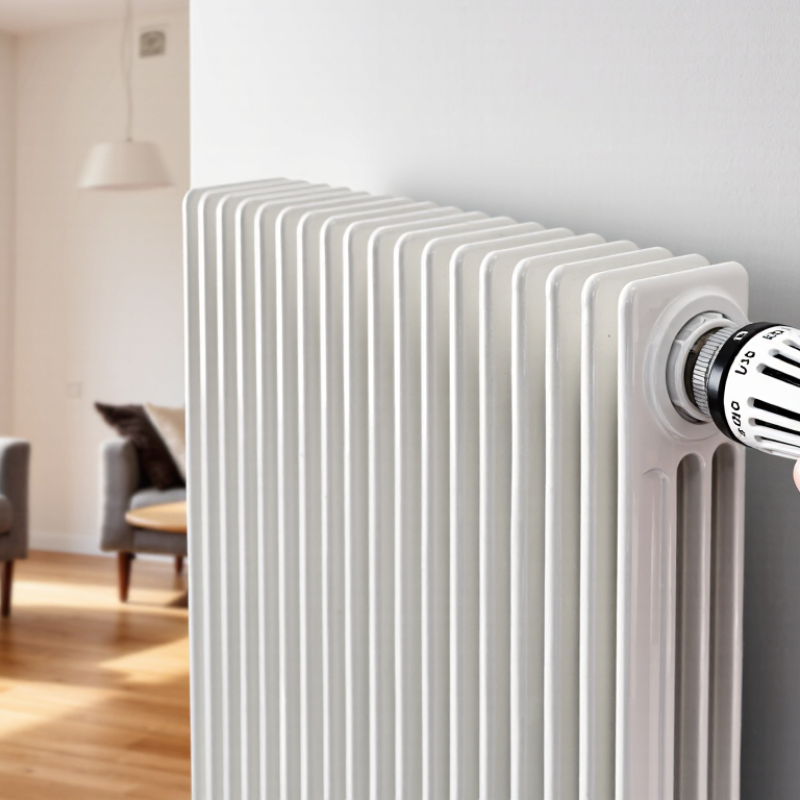
A TRV is a thermostatic radiator valve fitted to a radiator inlet. It controls hot-water flow according to room temperature. The valve does not heat the room by itself. Instead, it adjusts radiator output as conditions change.
A typical TRV has a sensor head, valve body, internal pin, and flow seat. The sensor may contain wax or liquid. As room temperature rises, the sensor expands and pushes the pin inward. Flow decreases. When the room cools, the sensor contracts and allows more hot water through. The numbered dial represents temperature ranges, not exact degrees. A setting of 3 is often comfortable, but room size and insulation can change the result.
EN 215 specifies performance, dimensions, testing methods, and marking requirements for thermostatic radiator valves. It helps manufacturers and installers assess control accuracy, response, durability, and resistance to pressure. However, compliance with EN 215 does not guarantee perfect performance in every heating system. Installation quality still matters. The sensor needs free air around it. Curtains, furniture, or a nearby heat source can distort its reading. A common mistake is forcing the adjustment dial when the pin is sticking. Gentle inspection is safer, although professional servicing may be necessary. I would also avoid treating the scale as a laboratory measurement; it is only a practical control reference.
What Is a TRV Radiator and How Does It Work?
A TRV, or thermostatic radiator valve, regulates hot-water flow into a radiator. Its sensor sits inside the valve head, near the room air. As air temperature rises, wax or liquid inside the sensor expands. The expanding material pushes a small bellows, which moves the valve pin inward. This reduces water flow through the radiator. When the room cools, the sensor contracts and releases the pin. More heated water can then enter.
The mechanism is mechanical, quiet, and surprisingly sensitive. A setting near level 3 often targets about 20°C, but the exact temperature varies by valve and room conditions. The valve does not measure the entire room evenly. Curtains, furniture, sunlight, or a nearby radiator can distort the sensed temperature. Keep the sensor head exposed. Do not cover it with thick fabric.
The European Commission’s Eurostat report, Energy Consumption in Households, states that space heating represented about 62% of household energy use in the European Union in 2022. The International Energy Agency’s Energy Efficiency 2023 report also identifies buildings as responsible for roughly 30% of global final energy demand. Small control improvements matter.
Still, a TRV is not perfect. It reacts beside the radiator, not beside the sofa. In practice, a cold corner may remain uncomfortable while the valve has already reduced flow. EN 215 provides performance requirements for thermostatic radiator valves, but installation quality still affects results. The sensor needs clear airflow, and the valve pin should move freely during maintenance checks. A clever device, with limits.
How the sensor detects room temperature and moves the valve pin
This representative operating profile shows how a thermostatic radiator valve (TRV) responds to room temperature. As the sensed temperature approaches the 20°C setpoint, the thermostatic sensor expands and pushes the valve pin inward, reducing hot-water flow through the radiator. When the room cools, the sensor contracts, allowing the valve pin to move back and increase flow.
A thermostatic radiator valve, or TRV, controls heat entering a radiator. It senses nearby air temperature and adjusts the water flow automatically. The numbered dial usually runs from frost protection to maximum heat. It is not a timer.
Typical settings correspond to approximate room temperatures, not fixed guarantees. A frost setting may protect against temperatures below 7°C. Setting 1 often targets about 10–12°C, while setting 2 may provide roughly 15–16°C. Setting 3 commonly aims for 18–20°C, which suits many living rooms. Setting 4 may reach around 22–24°C, and setting 5 can approach 26–28°C. These figures vary between valves and rooms.
In practice, I have found that furniture can distort readings. A curtain covering the valve may trap warm air around its sensor. The radiator can then switch down too early. Room insulation, sunlight, drafts, and radiator size also affect the result. Place furniture clear of the valve where possible. Adjust one setting, then wait several hours before judging it. Small changes work better.
The dial is not perfectly precise. A room thermometer provides a more reliable check. If a room remains cold at setting 3, increasing the number may help, but the heating system itself could need inspection. Different rooms may need different settings, even on the same floor. Temperature comfort is personal, too. A target of 20°C may feel warm to one person and cool to another.
A TRV radiator uses a thermostatic radiator valve to control hot water entering the radiator. The valve senses the air temperature around it. As the room warms, its internal sensor expands and presses a small pin. This restricts water flow through the radiator. Less hot water means less heat released into the room.
When the room cools, the sensor contracts and allows more water through. The process is gradual, not an instant on-and-off switch. In daily use, this helps reduce heating demand in rooms that already feel comfortable. A bedroom may need less heat than a living room. Turning its TRV to a lower setting can prevent unnecessary energy use.
From practical installation experience, TRVs work best when their sensor can feel room air freely. Curtains, furniture, or a nearby heat source may distort the reading. The radiator may then stay cooler or warmer than expected. That can be frustrating. A TRV also cannot correct poor system balancing, trapped air, or an incorrectly sized radiator. Checking these issues matters before blaming the valve.
Users should adjust settings gradually and observe the room for several hours. A comfortable setting depends on insulation, outdoor weather, and personal preference. Small changes often work better than constantly turning the valve.
A thermostatic radiator valve, or TRV, controls water flow through a radiator. Its sensor reacts to the room temperature, not the radiator’s surface heat. When the room warms, the valve reduces flow. When it cools, the valve opens again. TRVs are useful in bedrooms, hallways, and rooms with different heating needs. They also support system balancing by preventing warmer rooms from taking excessive flow. However, a TRV cannot correct poor pipe sizing or a weak boiler system.
Correct installation matters. The valve sensor should remain exposed to room air, away from curtains, furniture, and direct sunlight. It should usually sit horizontally for accurate readings. During balancing, a technician adjusts lockshield valves so each radiator receives suitable flow. This may require measuring temperatures across the radiator, not guessing from touch. The process is not flawless. A room can still feel cold because of draughts, insulation gaps, or an undersized radiator. Maintenance includes checking for stiffness, leaks, and unusual noise before winter. Do not force a seized valve.
Tips: Turn the TRV down when a room is unused, but avoid shutting every radiator. Keep the sensor clear. Test each valve once yearly. If heating remains uneven, record room temperatures and ask a qualified heating professional to inspect the system. Small details matter.