
Financing

If you are interested in financing to fund your Bay-Lynx purchase, we recommend that you connect with Easylease Corp., a Canadian-based leasing and finance company that offers premier equipment leasing and financial services. They are focused on making it easier than ever before for companies to overcome cash flow and resource constraints to acquire the assets they need to grow their business.

Leasing through Easylease Corp. can offer several benefits:

  • Conserve Cash Leasing
  • 100% Financing
  • No Pre-Payment of Taxes
  • Preserve Lines of Credit
  • Potential Income Tax Benefits
  • Pay as You Profit
  • Match Revenue with Expenditures
  • Simple, Convenient Process
  • Tailored Payments

Click here for your Canadian instant lease quote >>

For US customers, Click here for your instant lease application >>

Top Karting Kart Manufacturers for Global Buyers

Choosing among the top Karting Kart manufacturers requires more than comparing horsepower or glossy product photos. Global buyers must assess safety, reliability, certification, delivery capacity, and long-term operating costs. A fast kart can still become an expensive problem when replacement parts arrive slowly.

Industry forecasts show continued expansion. Grand View Research’s 2024 go-kart market analysis projects steady growth through 2030, supported by recreational venues, electric powertrains, and family entertainment centers. Technavio’s 2024 market outlook also identifies rental facilities and battery-powered models as important growth areas. However, published estimates differ because some reports include rental fleets, while others focus on racing equipment. The market is not perfectly tidy.

That difference matters when comparing suppliers. A serious manufacturer should provide documented testing, clear technical specifications, and traceable component information. Buyers should also examine frame construction, braking systems, battery management, motor cooling, and controller protection. These details become visible on a busy track, where heat, dust, and repeated impacts test every weakness.

CIK-FIA technical regulations offer a useful professional reference for racing-oriented products. They help buyers evaluate chassis design, braking performance, protective equipment, and technical consistency. For recreational fleets, operators should additionally review local safety requirements, insurance expectations, and maintenance procedures.

Experience still counts. Ask for fleet references, service records, warranty terms, and spare-part lead times. Request a demonstration unit before placing a large order. A spreadsheet can still mislead. The best manufacturer balances performance, safety, documentation, and dependable support across borders. This guide compares leading global suppliers through those practical standards, while recognizing that no single brand fits every buyer, venue, or budget.
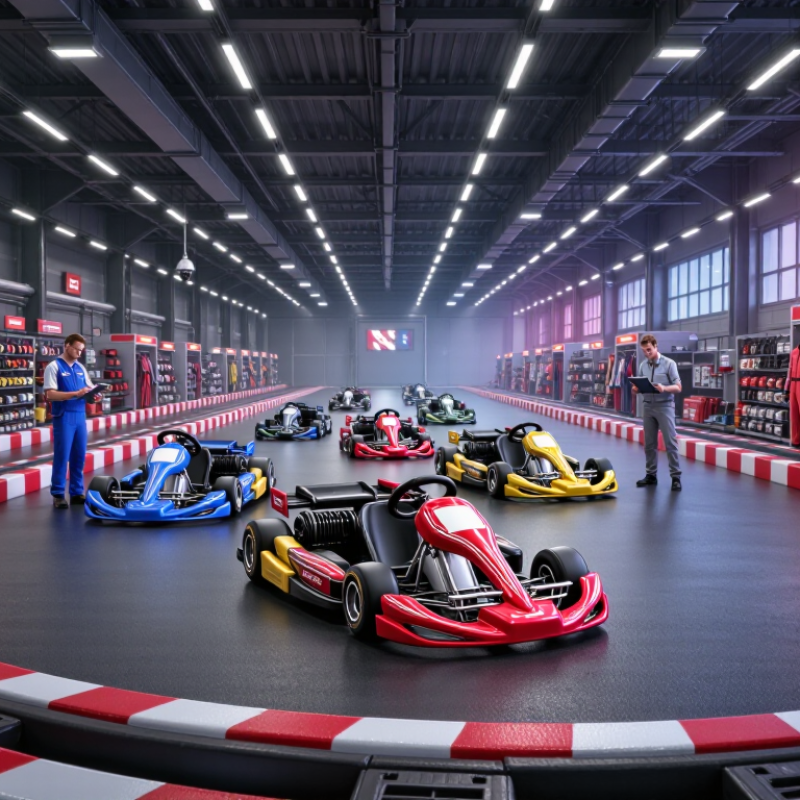
Top Karting Kart Manufacturers for Global Buyers

Karting Kart Manufacturers: Market Roles and Product Categories

Top Karting Kart Manufacturers for Global Buyers

Karting kart manufacturers serve different market roles, and buyers should identify the role before comparing prices. Some develop complete karts for leisure centers, racing schools, and private tracks. Others focus on chassis production, electric drive systems, engines, safety components, or contract manufacturing. Product categories usually include rental karts, competition karts, youth models, electric karts, and two-seat training vehicles. Each category needs different testing, maintenance planning, and operator training.

A rental kart may require a reinforced frame, adjustable pedals, impact protection, and simple battery access. A competition kart needs precise steering response, lightweight construction, and easily replaceable parts. Electric models can reduce local noise, but charging time and battery service remain practical concerns. Experienced buyers should request test reports, material details, spare-parts lists, warranty terms, and production records. Factory photos are useful, but they do not replace a physical inspection. I have found that a neat brochure can hide difficult maintenance.

Tips: Compare total ownership cost, not only the unit price. Ask for sample parts and assembly instructions. Check whether technical support covers your operating region. Confirm applicable safety and electrical requirements with qualified local professionals. Do not assume every “custom” option is proven; some modifications need further testing. Keep a written acceptance checklist. Small omissions become expensive later.

Karting Kart Manufacturers: Market Roles and Product Categories

Typical top-speed ranges by karting product category and market role. Values represent common industry ranges; actual specifications vary by configuration, track rules, battery capacity, engine tuning, and safety limits.

Source basis: commonly published specifications across recreational, rental, junior, sprint-racing, and shifter-kart product segments.

How to Evaluate Kart Manufacturers for International Purchasing

Choosing a kart manufacturer for international purchasing requires more than comparing prices. Experience shows that reliable suppliers explain their production process clearly. Ask about frame materials, welding methods, engine options, braking systems, and quality checks. Request recent test records, product drawings, and inspection photos. Vague answers deserve caution.

Evaluate communication as carefully as the kart itself. A professional manufacturer should provide consistent specifications, realistic lead times, and clear payment terms. Confirm packaging details, spare parts availability, warranty procedures, and after-sales support. Check whether the supplier can meet your destination’s safety, labeling, emissions, and import requirements. Independent inspections can reveal weak welds, uneven paint, loose fasteners, or missing documents. Small details matter.

Tips: Compare at least three manufacturers. Request a sample or video demonstration. Test steering, braking, acceleration, and seat adjustment before ordering in volume. Check how replacement parts are identified and shipped. Keep every specification in writing. I have found that polished presentations can hide poor follow-through. That risk is easy to underestimate. Also, a low quotation may exclude freight, tooling, customs charges, or essential accessories. Review the full landed cost, not only the factory price. Ask direct questions, but allow room for clarification. No supplier is perfect. Reliability develops through evidence, repeated communication, and careful verification.

Leading Kart Manufacturers by Vehicle Type and Application

Top Karting Kart Manufacturers for Global Buyers

Leading Kart Manufacturers by Vehicle Type and Application

Choosing a kart manufacturer starts with the vehicle’s working environment. Rental fleets need durable frames, simple controls, and quick battery or fuel servicing. Racing karts require precise geometry, adjustable axles, and consistent braking performance. Electric models suit indoor venues because they reduce local emissions and noise. Off-road karts need stronger suspension and protected drivetrains.

Grand View Research’s 2024 go-kart market analysis reports that rental applications held the largest market share. Its findings also identify electric propulsion as a strong growth area. Research and Markets’ 2024 industry profile similarly highlights recreational facilities and organized racing as major demand segments. These trends matter for buyers comparing manufacturers across applications. A high-speed racing chassis may perform poorly in a busy rental track. That mismatch becomes expensive.

Tips: Ask for cycle-life data, spare-part lead times, frame dimensions, and braking-test records. Request a loaded demonstration, not only a showroom drive. Check battery thermal protection for electric fleets. For racing, compare homologation documents and setup ranges. Do not trust attractive pricing alone. My own assessment would always include a wet-track test, where weaknesses appear quickly. Manufacturer claims can be incomplete. That is worth questioning.

Key Manufacturing Standards, Safety Features, and Customization Options

Top Karting Kart Manufacturers for Global Buyers

Key Manufacturing Standards, Safety Features, and Customization Options

Global buyers should assess the factory, not only the finished kart. A dependable manufacturer follows documented quality procedures, weld inspections, torque checks, and traceable component records. ISO 9001 certification can support consistency, but it does not replace product testing. For leisure karts, EN 16230-1 may apply in relevant markets. Competition models may require federation homologation. Ask for current test reports, material specifications, and inspection photos. Paperwork matters.

Safety begins with the chassis. A properly welded frame, protected chain or belt drive, secure steering joints, and responsive brakes reduce practical risks. Useful details include a reachable engine kill switch, speed control, rounded bodywork, and a strong bumper system. Electric karts need battery protection, insulation checks, thermal monitoring, and a tested charging system. Seat belts should never be added casually. Their suitability depends on kart design and local rules. Small parts matter.

Customization can cover seat size, pedal position, tire compound, gearing, body colors, telemetry, and electric power limits. Ask whether these changes are engineered or merely fitted after production. A sample inspection should include cold starts, brake tests, fastener checks, and several hours of operation. Do not trust polished photos alone. Request warranty terms, spare-part availability, and failure-response times before placing a large order. Some suppliers document factory tests well but provide limited long-term failure data. A modest pilot shipment may reveal more than a confident sales presentation.

Global Sourcing Factors: Pricing, Certification, Shipping, and Support

Top Karting Kart Manufacturers for Global Buyers

Global Sourcing Factors: Pricing, Certification, Shipping, and Support

Price should be judged beyond the factory quotation. Compare the chassis, engine or motor, battery, tires, safety parts, and spare components. A low initial price can become expensive after replacement parts and repeated freight charges. Request a clear quotation with tooling, packaging, payment terms, and warranty coverage listed separately. Keep some budget for unexpected adjustments.

Certification depends on the destination and the kart’s intended use. Ask for test reports, material records, user manuals, and conformity documents before placing a large order. Electric models may require battery and charger documentation, while fuel-powered models need different technical checks. Documents should match the exact model, not a similar sample. This detail is often overlooked.

Shipping requires practical planning. Confirm carton dimensions, gross weight, loading quantity, and whether the karts ship assembled or partly disassembled. Moisture protection matters when metal frames travel through humid ports. Ask about delivery terms, customs paperwork, and replacement procedures for transit damage. Support quality is easier to judge through response time and technical clarity. Request spare-parts lists, assembly guidance, and video troubleshooting. Some suppliers promise fast help, but replies may slow after payment. That risk deserves honest consideration. A small trial order can reveal packaging quality, communication habits, and real production consistency before a larger commitment.

Top Karting Kart Manufacturers for Global Buyers - Global Sourcing Factors: Pricing, Certification, Shipping, and Support
Manufacturing Profile Typical Product Range Indicative Unit Price (USD) Common MOQ Typical Production Lead Time Certification and Compliance Shipping Considerations After-Sales Support
Entry-Level Petrol Kart Production Basic recreational karts with tubular steel frames, mechanical brakes, air-cooled engines, and standard safety guards. $900–$1,800 5–20 units 30–60 days CE documentation may be available EN 16230 relevant for leisure karts Destination-specific safety review is required. Usually shipped by sea in wooden cases or metal frames. One 20-foot container commonly carries approximately 18–30 assembled units, depending on kart dimensions and packing method. Remote assembly instructions, spare-part lists, basic troubleshooting, and a typical 6–12 month limited warranty.
Mid-Range Petrol Rental Kart Production Commercial rental karts with reinforced chassis, adjustable pedals, bumpers, chain guards, hydraulic or upgraded mechanical braking systems, and higher-duty components. $1,800–$3,500 5–15 units 45–75 days CE technical file support EN 16230 alignment commonly requested Risk assessment, user manuals, and emergency-stop requirements should be confirmed for the intended venue. Sea freight is generally the most economical option. Buyers should request impact-resistant export packaging and confirm whether spare engines, batteries, or oils create dangerous-goods restrictions. Replacement wear parts, maintenance schedules, video training, and optional commissioning support. Warranty terms commonly exclude wear items and misuse.
Performance Petrol Kart Production Higher-output karts with performance engines, improved steering geometry, upgraded brakes, reinforced frames, and adjustable driving positions. $3,000–$7,500 2–10 units 60–90 days CE marking support where applicable Engine emissions rules vary Track-use products may require different documentation from public-road vehicles; verify local noise, emissions, and venue rules. Each kart may require dedicated crating because of larger engines and performance components. Transit insurance and pre-shipment inspection are recommended for higher-value orders. Technical setup guidance, replacement components, engine service information, and optional driver or mechanic training.
Electric Rental Kart Production Battery-powered rental karts using lead-acid or lithium battery systems, electric drive units, programmable speed controls, and charging infrastructure. $2,500–$8,000 5–20 units 60–100 days CE/LVD/EMC may apply in the EU UN 38.3 for lithium battery transport Battery test summaries, SDS documentation, charger compliance, and local electrical requirements must be verified before shipment. Lithium batteries are regulated as dangerous goods. Air freight is costly and restricted; sea freight requires correct UN packaging, labels, declarations, and carrier approval. Battery management guidance, charger support, controller diagnostics, software configuration, and battery warranty terms that often depend on cycle count and operating conditions.
Electric Competition or High-Performance Kart Production High-power electric systems with liquid or advanced air cooling, data logging, regenerative braking options, adjustable controllers, and competition-oriented chassis components. $6,000–$15,000+ 1–5 units 75–120 days Battery transport compliance required EMC and electrical safety assessment recommended Motorsport regulations, battery enclosure requirements, and event-specific technical rules may apply. Specialized crating, battery state-of-charge limits, dangerous-goods documentation, and professional installation planning are important. Customs classification should be confirmed before ordering. Remote diagnostics, firmware support, commissioning, performance setup, and paid engineering assistance are commonly available.
Custom OEM/ODM Kart Manufacturing Buyer-specific chassis geometry, body panels, colors, decals, powertrains, telemetry, safety systems, packaging, and private-label documentation. $2,000–$20,000+ 10–100+ units 90–180 days after design approval Compliance depends on destination Prototype testing is essential Buyers should define technical files, risk assessments, manuals, labels, battery documents, and conformity responsibilities in the purchase contract. Prototype shipments may use air or express freight; production orders normally use sea freight. Tooling, packaging design, container loading, import duties, and destination handling should be priced separately. Dedicated project management, engineering change control, spare-parts planning, training materials, and negotiated warranty and service-level agreements.
Replacement Parts and Fleet Support Supplier Frames, bumpers, brake components, steering parts, wheels, tires, chains, controllers, chargers, batteries, engines, and consumable maintenance kits. $5–$3,000 per item 10–100 pieces per item 15–45 days for standard parts Part-specific requirements may include material declarations, battery transport documents, charger safety compliance, and chemical SDS documentation. Small parts are suitable for courier or air freight; batteries, engines, lubricants, and oversized frames require separate transport planning and may incur hazardous-goods or dimensional surcharges. Recommended support includes parts diagrams, compatibility tables, stock planning, technical helpdesk access, and agreed response times for urgent fleet failures.
Buyer verification note: Prices, MOQs, lead times, freight capacity, and compliance documents are indicative market benchmarks rather than universal specifications. Before placing an order, request a current quotation, product test reports, conformity documentation, battery or engine transport files, warranty terms, spare-parts availability, and a pre-shipment inspection.

Article Source: