
If you are interested in financing to fund your Bay-Lynx purchase, we recommend that you connect with Easylease Corp., a Canadian-based leasing and finance company that offers premier equipment leasing and financial services. They are focused on making it easier than ever before for companies to overcome cash flow and resource constraints to acquire the assets they need to grow their business.
Leasing through Easylease Corp. can offer several benefits:
Click here for your Canadian instant lease quote >>
For US customers, Click here for your instant lease application >>
Choosing the right Fire Pump Hose affects water flow, pump performance, and crew handling. The main options include suction hose for drawing water into a pump, discharge hose for carrying pressurized water, and supply hose for moving larger volumes over distance. Attack hose is typically selected for controlled handling near the fire, while booster hose suits some smaller, compact applications. Details matter.
Each type serves a different job. Suction hose must resist collapse under vacuum; discharge and attack hoses must match the pump’s working pressure and intended use. Supply hose diameter, length, and coupling style can influence flow and setup time. A hose that looks suitable may still be incompatible with a pump connection or operating pressure. Check the manufacturer’s specifications, coupling measurements, and inspection guidance before choosing. Applicable standards can vary by region, so verify the requirements for your equipment and location.
This guide compares common fire pump hose types, their materials, strengths, and practical limitations. It also considers factors such as abrasion, temperature exposure, storage, and maintenance. A clean product table is helpful, but it cannot replace checking the hose in its actual working conditions. That part is easy to overlook. The best choice is not always the largest or most rugged option; it is the hose that reliably meets the pump’s demands and can be handled safely by the crew. A little uncertainty remains until the equipment is tested and inspected together.
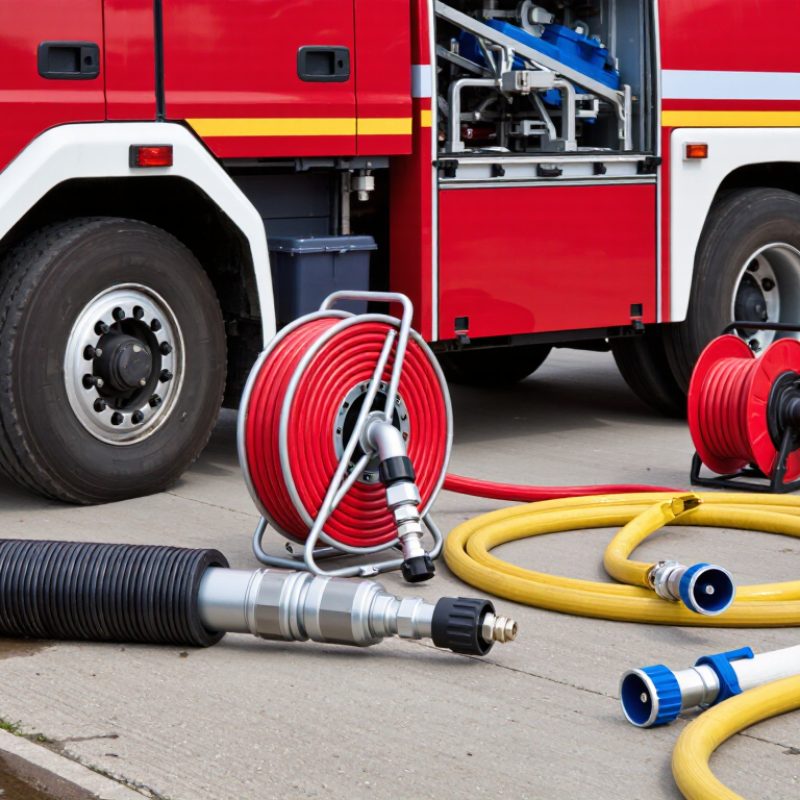
Fire pump hose is best understood by its job, not just its diameter. NFPA 1961 addresses hose construction and performance, while NFPA 1962 covers care, inspection, service testing, and replacement. Together, they help distinguish attack hose, supply hose, and booster hose by operational role. Attack hose carries water from the pump toward the nozzle. Supply hose moves larger volumes between a hydrant, relay pumper, or apparatus. Booster hose is compact and commonly used for smaller, quick-response streams. Not interchangeable.
NFPA 1962’s annual service-testing schedule is a practical readiness benchmark: crews should not rely on appearance alone. A hose can look sound while its lining, coupling, or jacket has deteriorated. The correct test procedure and pressure depend on hose type and the applicable standard edition, so departments should check their adopted requirements rather than use one pressure for every line. That distinction matters. On an apparatus, a large-diameter supply line feeding a pump has a different task from a smaller attack line stretched across a wet floor. I still find “fire pump hose” a vague label; identifying its function, test history, and condition gives a more dependable picture.
What Are the Top Fire Pump Hose Types?
Evaluate Rigid Suction Hose for 100–150 psi Pump Inlet Service
Rigid suction hose is built to resist collapse when a pump draws water under vacuum. For 100–150 psi inlet service, however, vacuum strength alone is not enough. Check the hose’s documented working-pressure rating and confirm it covers the system’s normal pressure and possible surges. That distinction matters. A hose may handle suction well yet be unsuitable for positive pressure. Verify ratings for the complete assembly, including couplings and clamps, not just the hose body.
Match the hose diameter to the pump inlet and keep the run as straight as practical. Sharp bends, loose connections, or a crushed section can restrict flow and invite leaks. Check the service temperature and water compatibility, too. In field assessments, small details often matter: a coupling that feels secure by hand may still need the specified tightening method. I would not assume that a “rigid suction” label confirms suitability for 150 psi. Request the manufacturer’s pressure and vacuum data, then compare it with the pump requirements.
Tips: Inspect the hose for cracks, soft spots, and damaged couplings before use. Keep it straight. Recheck connections after positioning, and follow the pump and hose instructions for pressure limits.
Compare 1.5-Inch Attack Hose at Typical 95–125 GPM Flow
At roughly 95–125 GPM, a 1.5-inch attack hose can suit handline operations, but hose diameter alone does not determine delivered flow. Nozzle choice, hose length, elevation, and pump pressure all affect performance.
That matters.
A long line or sharp bend can increase friction loss and reduce nozzle pressure.
Common constructions include single-jacket, double-jacket, and rubber-covered hose. Single-jacket designs are often lighter to move through tight spaces. Double-jacket constructions add an outer textile layer for abrasion resistance, though they may feel bulkier. Rubber-covered hose has a smooth outer surface that can be easier to clean.
Not always.
Weight, flexibility, and durability vary by specific hose, so compare actual specifications rather than relying on type names alone.
For a 95–125 GPM target, check the hose’s rated pressure and the nozzle’s flow characteristics together. A practical drill can reveal issues a spec sheet cannot: a coupling snagging on a doorway, a line kinking around a corner, or a crew tiring while advancing it.
I would not assume the lightest hose is best. Test the intended setup under realistic conditions, and follow the hose maker’s inspection and maintenance instructions.
A 2.5-inch supply hose is a practical choice when a fire pump must move approximately 250 gallons per minute. Its capacity supports many medium-flow operations while remaining manageable for trained crews. Actual delivery depends on hose length, internal diameter, elevation, coupling condition, and pump pressure.
Friction loss increases with flow and distance. A long supply line can reduce pressure before water reaches the pump or manifold. Crews should confirm the expected flow with calibrated gauges and current hydraulic data. The hose should lie as straight as possible, without sharp bends, crushed sections, or trapped air. Connections need careful inspection. A damaged gasket can waste water and create a dangerous pressure change.
Field experience shows that the 250 GPM figure is only an estimate. It should not replace a flow test. I have seen apparently sound hose perform poorly after storage, dragging, or repeated coupling impacts. That detail is easy to miss. Regular inspection should check the jacket, couplings, seals, and identification markings. Pressure testing must follow the applicable safety procedure and the hose manufacturer’s limits. In some layouts, a larger hose may reduce friction loss; in others, access and handling may matter more. The best selection matches the pump, distance, terrain, and required flow—not a number printed on a planning sheet.
Assessing 2.5-Inch Supply Hose for Approximately 250 GPM Delivery
The chart highlights 250 GPM as an approximate assessment point, not a guaranteed hose capacity. Actual flow depends on hose length, pump pressure, elevation, fittings, and hose condition. Confirm operating limits and flow performance using the hose specifications and applicable fire-service procedures.
For high-volume operations, choose large-diameter hose above 3 inches. Common sizes include 4, 5, and 6 inches. These supply hoses move substantial water from a hydrant or portable pump. Their wider interior reduces friction loss during long water lays. That matters when a pumper must maintain steady flow at a distant scene. A 5-inch hose can carry more water with less resistance than a smaller attack line. However, it also weighs more when charged. Handling becomes difficult on narrow streets or uneven ground.
Material selection deserves close attention. Reinforced synthetic jackets resist abrasion, moisture, and repeated deployment. Flexible construction helps crews reposition hose around parked vehicles and sharp corners. Couplings should match the hose diameter, pump connections, and local operating procedures. Inspect threads, gaskets, jacket cuts, and signs of heat damage before every shift. Small defects can become serious under pressure. They often hide near couplings.
Pressure ratings must fit the pump system, not just the expected flow. Test data, manufacturer instructions, and applicable fire-service standards provide essential guidance. Field crews should also consider storage space, bending radius, and drainage after use. Bigger is not always better. A 6-inch hose may deliver excellent volume, yet a 4-inch line can be faster to deploy. That trade-off deserves honest review after training exercises. Sometimes the best choice is the hose crews can move correctly.