China Top Illuminated Tact Switch Manufacturers
China’s position in Illuminated Tact Switch manufacturing matters to product teams building compact, backlit controls for appliances, automotive cabins, instruments, and consumer electronics. IDC reported that worldwide smartphone shipments reached 1.24 billion units in 2024, a 6.4% increase year over year. That figure is not a tact-switch market estimate. It does, however, illustrate the scale of electronics production where small, dependable controls remain relevant.
Small parts. Real consequences.
An Illuminated Tact Switch combines a momentary switching action with a visible light source, often an LED beneath a translucent cap. Buyers should compare more than unit price: actuation force, travel, electrical rating, illumination uniformity, mounting style, and expected operating life all affect suitability. Datasheets help, but samples reveal details a table may miss, such as uneven light near the cap edge or a tiring click during repeated use. China’s supplier base offers a broad range of configurations; capabilities and quality systems still vary, so qualification matters.
Design researcher Donald Norman writes, “Good design is actually a lot harder to notice than poor design, in part because good designs fit our needs so well that the design is invisible.” His observation concerns design broadly, not tact switches specifically, but it fits the goal of a clear, unobtrusive control. For this guide to China’s top manufacturers, we emphasize documented specifications, production capabilities, and practical evaluation. One limitation remains: published market data rarely isolates illuminated tact switches, so supplier claims should be checked against datasheets and sample testing.
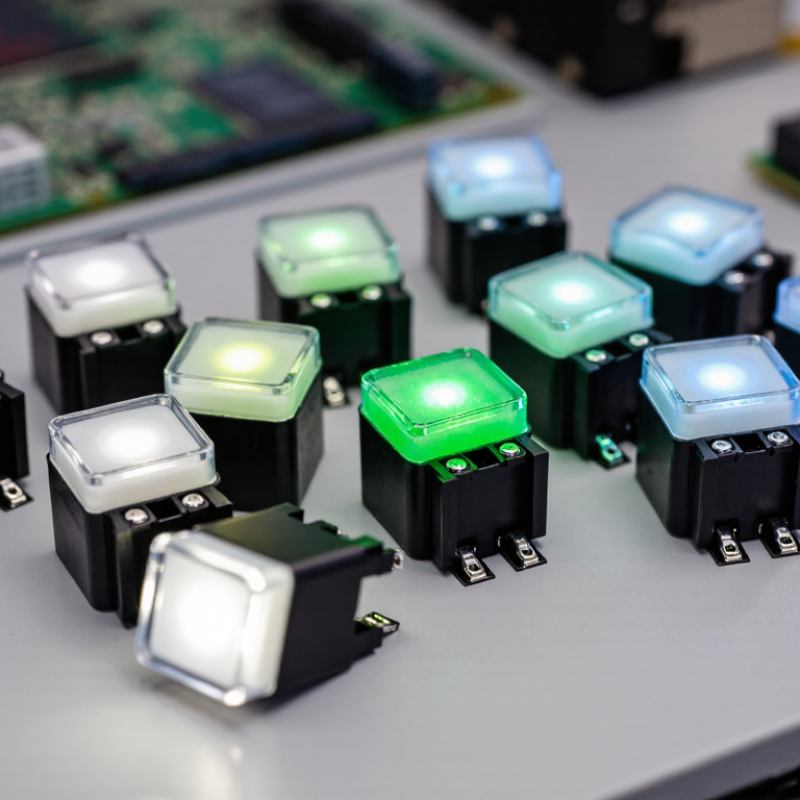
Illuminated Tact Switches Explained: LED, Contacts, and Common 6 × 6 mm Formats
An illuminated tact switch combines a momentary contact mechanism with a small LED, making it useful when a button needs a visible status cue. Pressing the actuator closes the switch contacts; releasing it usually opens them again. Many common designs use normally open contacts, but terminal layouts and switching behavior should always be checked against the datasheet. A clear click helps confirm operation. It does not prove the LED circuit is wired correctly.
In a typical 6 × 6 mm format, the body may look standardized, while actuator height, pin spacing, and LED terminals can differ. Check the PCB footprint before ordering, and confirm LED polarity: reversing the positive and negative connections may prevent illumination. The LED may have separate terminals from the switch contacts, so treat the two circuits independently unless documentation shows otherwise. During prototyping, test the button with the intended supply and current-limiting resistor. Small parts are easy to misread. Even a careful layout can miss a pin detail, so compare the physical sample with the drawing before a production run. That extra check may feel repetitive, but it can prevent rework.
Illuminated Tact Switches Explained: LED Forward-Voltage Ranges
The chart shows representative forward-voltage ranges for common LED colors; actual values depend on the LED and its operating current, so check the component datasheet. In an illuminated tact switch, the LED circuit is separate from the mechanical switch contacts. Many designs use a 6 × 6 mm switch footprint, but dimensions and terminal layouts vary.
Quality and Compliance: IEC 61058-1 Testing and RoHS Requirements
For illuminated tact switches, compliance starts with the switch’s intended use and rated conditions. IEC 61058-1 testing can assess electrical and mechanical performance, including endurance, temperature rise, and insulation. The exact test plan depends on the product design, rating, and applicable edition of the standard. A glowing indicator does not prove that the switch contacts meet their rating. Test them separately.
Good records matter. Keep test reports, drawings, ratings, and production specifications together. RoHS checks focus on restricted substances in homogeneous materials, not just the finished switch as a whole. Plating, solder, plastics, and cable insulation may each need supporting material data.
Supplier declarations help, but they should match the actual components and manufacturing process. A declaration can become outdated after a material change. That is easy to miss. Manufacturers should verify changes and retain evidence, using suitable laboratory testing when documentation leaves uncertainty.
Also check the requirements of the destination market; RoHS obligations and accepted documentation can vary. Paperwork alone is not enough. A practical compliance review connects test results to the exact illuminated tact switch being supplied.
China’s Leading Manufacturers: Compare Product Range, Customization, and Capacity
China’s illuminated tact-switch suppliers differ less by headline claims than by engineering depth. Compare their ranges across SMT and through-hole designs, cap sizes, actuator heights, LED colors, and operating forces. A 6 mm square switch may fit a compact control panel, while a taller actuator can improve access through a thick enclosure. Ask for drawings, force curves, and LED voltage options—not just a catalog page. Small details matter.
WSTS’s Spring 2024 forecast projected global semiconductor sales of US$611.2 billion in 2024, up 16% year over year. This is not a tact-switch market estimate, but it signals continued activity across electronic-device supply chains. Buyers should compare customization options against actual production evidence: sample lead time, tooling charges, monthly output, inspection records, and capacity during peak demand. Request a pilot lot. Check consistency.
Capacity claims need context. A large stated output means little if LED brightness, actuation feel, or solderability shifts between batches. Ask whether suppliers can provide incoming-material checks and test results for operating life, contact resistance, and environmental conditions. Confirm how engineering changes are documented. Still, a broad product range can mislead; some custom colors or caps may require new tooling and longer validation. Get the trade-offs in writing.
Choosing a Supplier: Match Actuation Force, LED Color, Dimensions, and IP Rating
When evaluating China’s illuminated tact switch manufacturers, match actuation force to the user and the panel. A light press can suit frequent operation; a firmer click may prevent accidental inputs. Request force curves and test samples, not just a nominal force value. Small details matter. Check LED color under the actual lens and ambient lighting, since a tinted cap can shift perceived color. Ask for the specified color coordinates and brightness tolerances.
Dimensions must fit the PCB footprint, panel cutout, cap height, and available travel. Even a small height mismatch can leave a button recessed or prone to sticking. Confirm drawings and tolerances before tooling, then test a sample in the assembled panel. Request lifecycle and environmental test conditions, too. Numbers need context.
For exposed equipment, specify the required IP rating for the installed assembly, not only the switch component. IEC 60529 defines IP test classifications; for example, IP6X denotes dust-tight protection, while IPX7 covers temporary immersion under defined test conditions, typically up to one metre for 30 minutes. These ratings do not guarantee performance in every installation. Ask suppliers for test reports, sealing details, and confirmation that the bezel, PCB, and enclosure maintain the intended protection after assembly.