Financing

If you are interested in financing to fund your Bay-Lynx purchase, we recommend that you connect with Easylease Corp., a Canadian-based leasing and finance company that offers premier equipment leasing and financial services. They are focused on making it easier than ever before for companies to overcome cash flow and resource constraints to acquire the assets they need to grow their business.

Leasing through Easylease Corp. can offer several benefits:

  • Conserve Cash Leasing
  • 100% Financing
  • No Pre-Payment of Taxes
  • Preserve Lines of Credit
  • Potential Income Tax Benefits
  • Pay as You Profit
  • Match Revenue with Expenditures
  • Simple, Convenient Process
  • Tailored Payments

Click here for your Canadian instant lease quote >>

For US customers, Click here for your instant lease application >>

Top Industrial Concrete Mixer Buying Guide for Global Buyers?

In the global construction industry, the demand for efficient and reliable industrial concrete mixers is on the rise. According to a recent market analysis by Industry Research, the concrete mixer market is projected to reach USD 8.2 billion by 2025, reflecting an annual growth rate of 3.9%. This indicates a strong need for high-quality mixers that meet various operational demands.

Selecting the right industrial concrete mixer is crucial. It can influence project timelines and budget efficiency. The right mixer can enhance productivity, reduce material waste, and improve concrete quality. However, many buyers struggle with factors like capacity, power, and mobility. Inadequate research may lead to choosing a mixer that does not fit specific project needs.

When investing in an industrial concrete mixer, understanding the specifications is vital. Features like mixing capacity, drum type, and durability directly affect performance and longevity. Neglecting these elements often results in frustrating operational challenges. Buyers should prioritize reliable suppliers who provide comprehensive support and after-sales services, ensuring that their investment is sound and beneficial.
Top Industrial Concrete Mixer Buying Guide for Global Buyers?

Understanding Different Types of Industrial Concrete Mixers

When considering an industrial concrete mixer, it's essential to understand the different types available on the market. Each type caters to specific needs and operational conditions. Tumble mixers are popular for their efficiency in blending various materials. They rotate around an axis, making them ideal for small to medium batches. In contrast, planetary mixers offer superior mixing quality, thanks to their unique design, which moves in a rotating and orbiting manner.

Tips: Always assess your project's scale before selecting a mixer. Understand the production capacity you need. This will guide your choice effectively.

Additionally, there are continuous mixers that keep mixing while feeding. These are beneficial for high-volume tasks but require a well-planned operation. A good understanding of each type can prevent costly mistakes. For example, using a tumble mixer for large productions may lead to inconsistencies.

Another consideration is the power source. Electric mixers are quieter and easier to maintain. Diesel mixers offer mobility but may require additional management. Evaluate your site conditions to make the right choice. Balancing power and operational ease is key.

Key Features to Consider When Purchasing a Concrete Mixer

Top Industrial Concrete Mixer Buying Guide for Global Buyers?

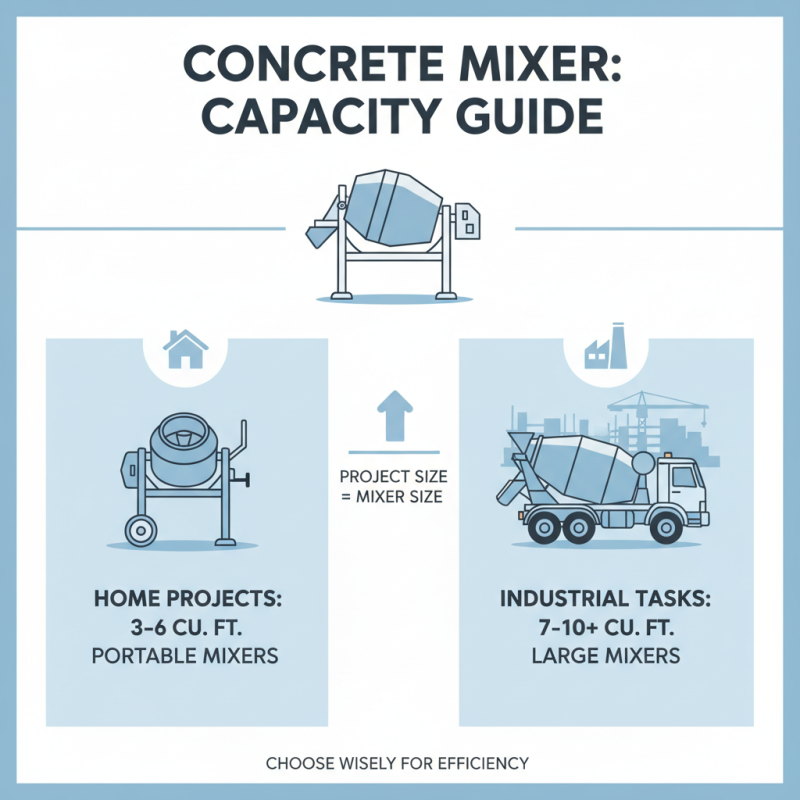
When purchasing a concrete mixer, key features play a vital role. One major aspect is the mixer capacity. Choose a size that meets your project demands. Common capacities range from 3 to 10 cubic feet. Small, portable mixers work for home projects. Larger models suit industrial tasks.

Power source is another consideration. Electric mixers are user-friendly and ideal for indoor work. Gasoline-powered models offer mobility for outdoor jobs. Assess where you will use the mixer. Each option has its own benefits based on location.

**Tip:** Consider the drum style. A tilt drum is great for pouring, while a drum with a fixed mixer allows greater mixing without spillage.

Look at the build quality. A sturdy mixer will last longer and withstand heavy use. Evaluating the warranty is essential too. Warranties indicate the manufacturer's confidence in their product.

**Tip:** Always check reviews. Real user feedback provides insights into the mixer’s performance. Engage with online forums for discussions.

Pay attention to the ease of cleaning. If it’s difficult to clean, residue can build up and affect future batches. Think about maintenance needs as well—this impacts the total cost of ownership. Aim for a balance of cost and quality to get the best long-term investment.

Evaluating Mixer Capacity and Output Requirements

When selecting an industrial concrete mixer, evaluating capacity and output requirements is critical. Capacity refers to the volume of concrete the mixer can handle at one time. It is essential to choose a mixer with a capacity that matches your project’s needs. A mixer that is too small may lead to delays. A mixer that is too large may result in wasted materials.

Tips: Always consider your project's scale. If you anticipate large pours, opt for a model with higher capacity. Conversely, for smaller jobs, a compact mixer may suffice.

Output requirements detail the speed at which your project can progress. A mixer that operates too slowly can hinder timelines. Look for models with adjustable speeds to accommodate different mixes. This ensures efficiency in various conditions.

Tips: Assess how often you'll use the mixer. For frequent use, invest in a reliable model. For occasional projects, renting might be wise.

Reflect on your specific applications. Understand the different material types you will mix. This can also influence your choice in capacity and functionality. It’s not just about the amount; it’s about how well the mixer serves your unique requirements.

Assessing Durability and Maintenance Needs for Longevity

When selecting an industrial concrete mixer, durability is a critical factor. A mixer’s longevity hinges on the materials used in its construction. Look for options made from high-quality steel or reinforced components. These materials can withstand heavy loads and harsh working environments. Regular maintenance plays a vital role in preserving their functionality. This includes routine checks of moving parts and seals, which can wear down over time.

Consider the maintenance requirements that come with each model. Some mixers are designed for easy access to components, allowing for quick repairs. Others may pose challenges, leading to inconvenient downtime. Evaluating how simple it is to obtain replacement parts is essential. A reliable supply line can enhance longevity, ensuring the mixer remains operational.

A concrete mixer is more than just a machine; it's a long-term investment. Owners may overlook the importance of maintenance in their initial buying decisions. Neglecting this area can lead to greater expenses and reduced productivity. Regular upkeep not only extends the machine's life but also enhances its performance. Prioritizing both durability and maintenance needs will serve buyers well in the competitive field of industrial mixing.

Top Industrial Concrete Mixer Buying Guide for Global Buyers

Feature Description Durability Rating Maintenance Frequency
Frame Material High tensile steel for strength Excellent Annual
Drum Capacity Varies from 100L to 400L Good Semi-Annual
Mixer Type Planetary or Drum Mixer Very Good Quarterly
Power Source Electric or Diesel Good Monthly
Weight Ranges from 500kg to 2000kg Excellent Annual

Analyzing Price Range and Brand Reputation in the Market

Top Industrial Concrete Mixer Buying Guide for Global Buyers?

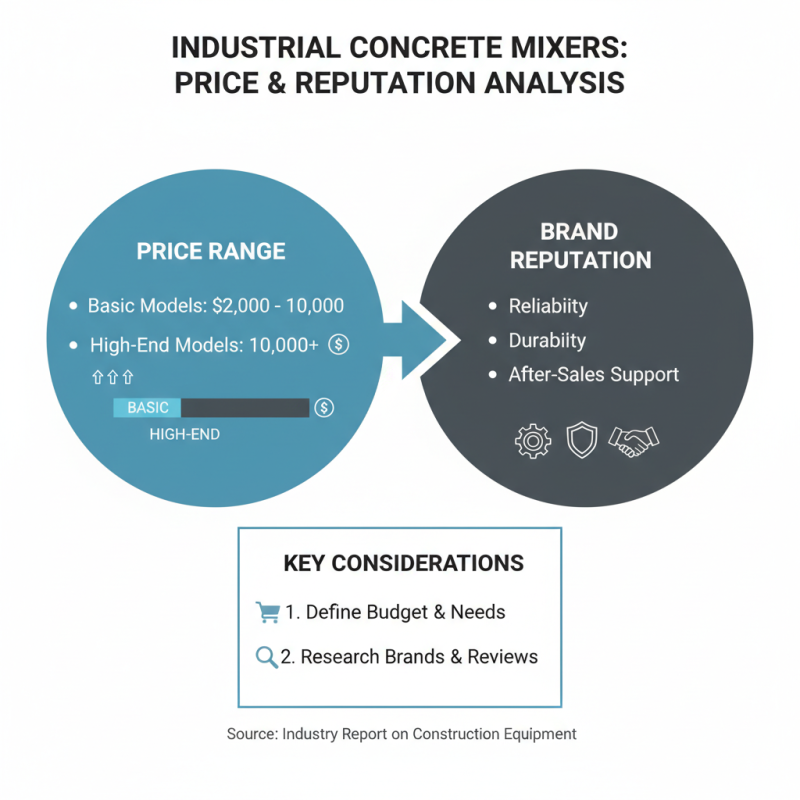
When considering the purchase of an industrial concrete mixer, price range and brand reputation play vital roles. Prices can vary significantly based on features and capacity. A basic mixer might start around a few thousand dollars, while high-end models can exceed tens of thousands. Understanding your budget is essential before diving into specific models.

Brand reputation is equally crucial. Reliable brands often offer better service and warranty options. However, emerging brands might provide innovative designs at lower prices. This creates a dilemma—should you trust established names or explore newer options? Evaluating customer reviews can provide insights into overall performance and durability.

It's important to note that a low price does not always equal quality. Sometimes, mixers with appealing price tags may lack durability. Conducting thorough research on user experiences and product specifications can help avoid future pitfalls. The balance between cost and reliability is a common challenge for global buyers. Never underestimate the value of thorough evaluation before making a significant investment.