If you are interested in financing to fund your Bay-Lynx purchase, we recommend that you connect with Easylease Corp., a Canadian-based leasing and finance company that offers premier equipment leasing and financial services. They are focused on making it easier than ever before for companies to overcome cash flow and resource constraints to acquire the assets they need to grow their business.
Leasing through Easylease Corp. can offer several benefits:
Click here for your Canadian instant lease quote >>
For US customers, Click here for your instant lease application >>
Choosing a concrete mixer and pump is not just a matter of comparing output figures. The right machine must suit the mix, the pour location, and the crew’s daily work. A narrow driveway, a long delivery line, or a tight turning area can change the decision quickly. Small details matter.
Start with the job. Check the required concrete output, aggregate size, pumping distance, and vertical reach. Then compare these needs with the machine’s rated capacity, mixer volume, and pump pressure. A unit that looks powerful on paper may still slow a pour if its setup does not fit the site. The crew matters, too. Operators need clear controls, practical access for cleaning, and service support when wear parts need attention.
No expert quotation was supplied for this topic, so I won’t attach an invented statement to a named specialist. That matters. A false attribution would weaken an otherwise useful buying guide. Instead, use this field principle: “Match the machine to the pour, not the brochure.” It is a practical reminder, not a sourced quotation. Some choices remain uncertain until the site is measured and the mix is confirmed. This guide will help readers compare key specifications, assess operating needs, and spot trade-offs before choosing a concrete mixer and pump. A little caution can save a lot of waiting.
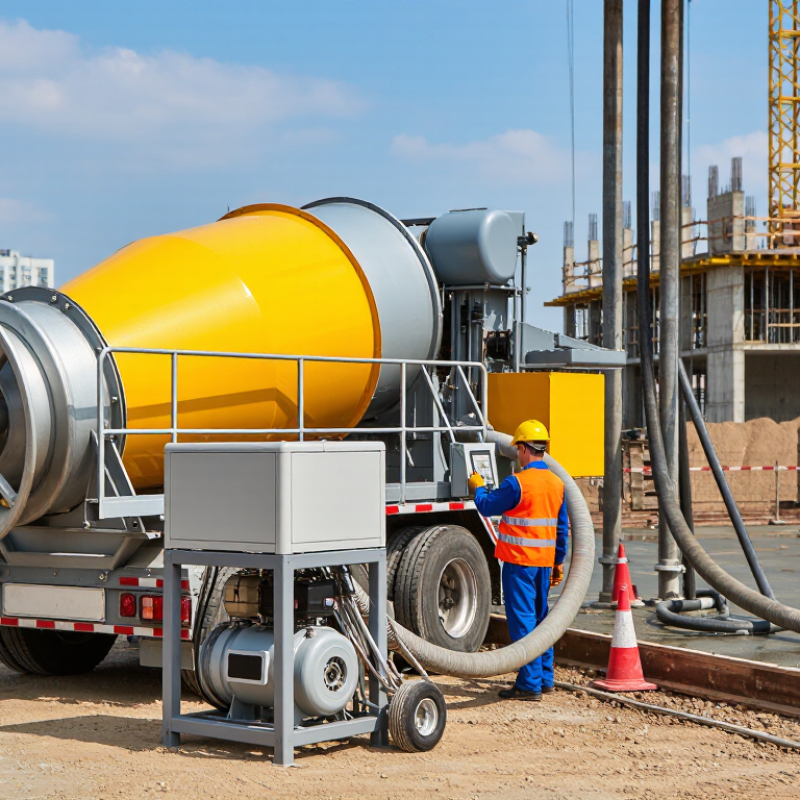
Before choosing a concrete mixer and pump, map the pour. A small driveway has different needs from a slab several floors above ground. Estimate the total concrete volume and the rate the crew can place and finish it. Measure the hose route, vertical lift, and distance from the truck to the pour. Tight gates, soft ground, or overhead obstructions can change equipment access. Allow time for setup and cleanup, too. Plans often underestimate these details.
Write down the concrete specifications before requesting equipment. Include the required strength, aggregate size, and target slump, then confirm the mix is suitable for pumping with the concrete supplier. Slump affects flow, but adding water on site can weaken concrete and should not be treated as a quick fix. Fibers or larger aggregate may also affect how smoothly the mix travels through a line. Check the pump’s stated capacity against the expected placement rate, not just the project’s total volume.
Small difference, big delay.
If the mix or site conditions are uncertain, discuss a trial or revised plan with the supplier and equipment operator. I would not rely on a rough estimate alone; actual delivery conditions can expose gaps in an otherwise tidy plan.
Compare Concrete Mixer and Pump Types
Concrete mixer-and-pump systems combine mixing and placing, but their layouts suit different jobs. A truck-mounted transit mixer can deliver fresh concrete to a separate boom pump, useful when crews must reach upper floors or pour across obstacles. A trailer line pump handles smaller sites and narrow access, though hoses need careful routing and manual repositioning. Integrated mixer-pumps reduce equipment moves on remote or modest pours. Their smaller output can become a bottleneck when placement demand rises. Pan and twin-shaft mixers suit controlled, on-site batching; transit mixers carry ready-mixed concrete and keep it agitated during travel. That distinction matters. A long haul can complicate timing.
Match the pump to the mix and the pour, not just the advertised output. ACI 304.2R-17, Placing Concrete by Pumping Methods, advises limiting aggregate size to about one-third of the pipeline’s inside diameter for angular stone, or two-fifths for rounded stone. Check the actual line diameter and mix design with the supplier. A USGS Mineral Commodity Summaries report estimated U.S. cement production at 91 million metric tons in 2023, a reminder of the material scale behind everyday pours. Still, national production figures cannot predict a site’s needs. A tight basement pour may favor a line pump; a tall, open slab may justify a boom. Walk the hose path, note bends and access, then compare required placement rate with the crew’s finishing capacity. That last check is easy to miss.
| System type | How it works | Typical placement and reach | Best suited for | Main advantages | Key limitations |
|---|---|---|---|---|---|
| Integrated trailer mixer pump | An on-board mixer prepares concrete, and an integrated concrete pump sends it through a delivery pipeline. | Set up near the pour; pipeline length and height depend on the pump model, mix, and site conditions. | Small or medium projects, remote sites, and jobs where ready-mix delivery is difficult. | Combines mixing and pumping in one unit; can reduce the need for separate mixer and pump equipment. | Requires a reliable supply of cement, aggregates, water, and admixtures on site; output is limited by the unit’s mixing and pumping capacity. |
| Transit mixer and stationary line pump | A ready-mix truck transports concrete in a rotating drum; a separate stationary pump feeds it into a pipeline. | The truck needs road access and a suitable discharge point; the pump can deliver through a routed line to the pour area. | Foundations, slabs, and other pours with road access but limited space for a placing boom. | Uses centrally batched concrete and flexible pipeline routing; practical for many mid-sized pours. | Depends on delivery scheduling and truck access; pipeline setup, priming, cleaning, and blockage prevention require attention. |
| Transit mixer and truck-mounted boom pump | Ready-mix concrete is discharged from a transit mixer into a pump truck, which places it through a hydraulically operated boom. | The boom reaches over obstacles within its rated working envelope; setup requires suitable ground and room for outriggers. | Large or fast-paced pours, multi-storey construction, and sites where overhead placement saves labor. | Rapid placement with fewer fixed pipelines; the boom can serve multiple locations from one setup position. | Higher equipment and mobilization costs; access, overhead clearances, ground bearing capacity, and safe outrigger placement must be checked. |
| On-site batching plant, mixer trucks, and stationary pump | A batching plant measures and mixes ingredients on site; mixer trucks carry the fresh concrete to a separate pump. | The plant needs space, utilities, aggregate storage, and truck circulation; the pump line is arranged to suit the pour. | Long-duration, high-volume, or remote projects with consistent demand and room for a production setup. | Can provide better control over batching and supply continuity when deliveries from an external plant are impractical. | Needs skilled operators, material storage, quality checks, maintenance, and site approvals; setup may not be economical for short jobs. |
| Selection note: Confirm required concrete volume and placement rate, pipeline distance and elevation, mix design and aggregate size, site access, ground conditions, power supply, and local safety requirements. Actual output and reach vary by equipment model, concrete properties, pipeline layout, and operating conditions. | |||||
Choosing a concrete mixer and pump starts with the pour, not the machine’s advertised maximum output. Estimate how much concrete the crew must place per hour, then allow for pauses, repositioning, and finishing work. A pump rated for high flow may still be a poor fit if the mix contains larger aggregate or must travel through a narrow hose. Check the concrete supplier’s mix guidance and the pump’s operating limits together. Small details matter.
Measure the actual delivery route, including horizontal hose runs, vertical lift, bends, and the distance from the truck to the pour. Each bend and height change adds resistance, so a long, winding line can reduce useful output. For example, a driveway pour near the mixer is different from filling a backyard footing behind a house. Walk the route before booking equipment. It sounds obvious, but rushed estimates miss obstacles. Keep a practical margin between expected demand and rated capacity, and confirm the setup with an experienced operator. A neat calculation can still be wrong when site access changes or the crew places concrete unevenly. Choose capacity for the real job, not the best-case number.
Choosing a concrete mixer and pump starts with the site, not the machine’s advertised output. Measure gate width, turning space, ground firmness, and the distance from the parking area to the pour. A compact unit may reach a narrow backyard, while a larger truck-mounted system may need stable access and room to maneuver. Measure the route, not just the pad. That matters. Wet soil, low branches, or a sharp driveway turn can stop a machine that looked suitable on paper.
Match power to the work and the available supply. Check the site’s electrical capacity, or confirm that fuel-powered equipment can operate where you plan to pour. Ask about realistic pumping distance and output with your mix; thick concrete and long hose runs can reduce performance. Keep hose connections away from walkways where possible, and plan where workers will guide the line. A bigger machine can seem like the safer choice, but it may add transport and setup problems without helping a small pour. Leave some capacity for delays, though estimating demand is rarely exact. Verify the setup with the operator before delivery, especially if the access route or ground conditions are uncertain.
When choosing a concrete mixer and pump, inspect safety features before comparing output rates. Look for accessible emergency stops, guarded moving parts, clear pressure gauges, and stable outrigger arrangements. Check that the controls are labeled and easy to reach from the normal operating position. A feature on paper is less useful if a worker cannot find it quickly.
OSHA’s 2023 construction fatality data recorded 1,075 worker deaths across the sector. This figure is not specific to concrete equipment, but it shows why equipment checks matter. Ask the supplier for a written maintenance schedule, inspection records, and clear instructions for checking hoses, clamps, and wear points. Confirm how quickly service technicians can respond and whether common replacement parts are available. A pump that sits idle waiting for a small part can disrupt a pour. I would still inspect the machine in person; a tidy service folder does not prove every component is sound.
Tips: Before each shift, test the emergency stop and inspect hose connections for damage or leaks. Keep a simple log of faults and repairs. Ask who provides operator training, too. Details can get missed when the site is busy.