Financing

If you are interested in financing to fund your Bay-Lynx purchase, we recommend that you connect with Easylease Corp., a Canadian-based leasing and finance company that offers premier equipment leasing and financial services. They are focused on making it easier than ever before for companies to overcome cash flow and resource constraints to acquire the assets they need to grow their business.

Leasing through Easylease Corp. can offer several benefits:

  • Conserve Cash Leasing
  • 100% Financing
  • No Pre-Payment of Taxes
  • Preserve Lines of Credit
  • Potential Income Tax Benefits
  • Pay as You Profit
  • Match Revenue with Expenditures
  • Simple, Convenient Process
  • Tailored Payments

Click here for your Canadian instant lease quote >>

For US customers, Click here for your instant lease application >>

How to Choose the Best Concrete Mixer Truck for Your Needs?

Choosing the right concrete mixer truck can greatly influence your construction projects. A concrete mixer truck is essential for transporting and mixing concrete efficiently. With numerous options available, it can be overwhelming to determine which one suits your specific needs.

Consider factors such as capacity, engine power, and features that enhance usability. For instance, a smaller mixer may be ideal for tight urban spaces, while larger models handle bigger jobs well. Balancing your budget with these features is crucial. However, costing can be tricky. Sometimes a more expensive model proves cost-effective in the long run.

Take time to evaluate your requirements before making a decision. An appropriate concrete mixer truck enhances productivity and minimizes downtime. Reflect on your choices and seek expert advice if needed. Finding the best mixer ensures that your projects run smoothly and efficiently.

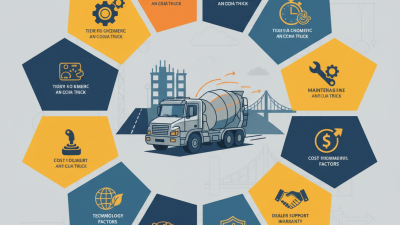
How to Choose the Best Concrete Mixer Truck for Your Needs?

Factors to Consider When Selecting a Concrete Mixer Truck

How to Choose the Best Concrete Mixer Truck for Your Needs?

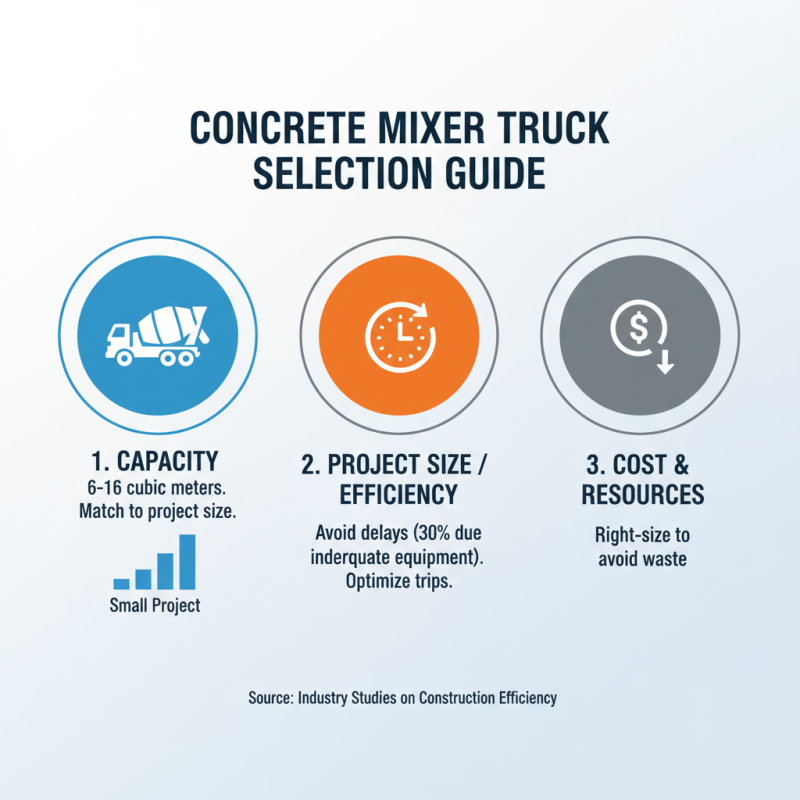
When selecting a concrete mixer truck, several factors come into play. Capacity is crucial. A typical concrete mixer truck has a drum capacity ranging from 6 to 16 cubic meters. Choose based on your project size. A truck that is too small could incur multiple trips, leading to delays. Conversely, an oversized truck can waste resources. Studies show that nearly 30% of construction delays are due to inadequate equipment.

Next, consider the mixing technology. Different mixers offer varying types of agitation. For instance, drum mixers are common for their reliability and efficiency in smaller projects. However, for larger jobs, twin-shaft mixers provide superior performance and faster mixing times. Industry reports indicate that using advanced mixing technology can improve the quality of concrete by up to 20%. This difference impacts structural integrity significantly.

Lastly, fuel efficiency matters. Concrete mixer trucks consume considerable fuel, impacting operational costs. A truck with better fuel efficiency can save significant amounts over time. Current trends suggest that many companies are switching to more eco-friendly options to reduce carbon footprints. Evaluating these aspects can clarify your decision, helping you choose the right mixer truck for your needs.
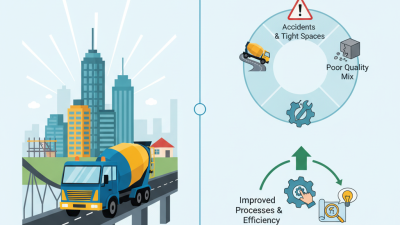

Understanding the Different Types of Concrete Mixers Available

How to Choose the Best Concrete Mixer Truck for Your Needs?

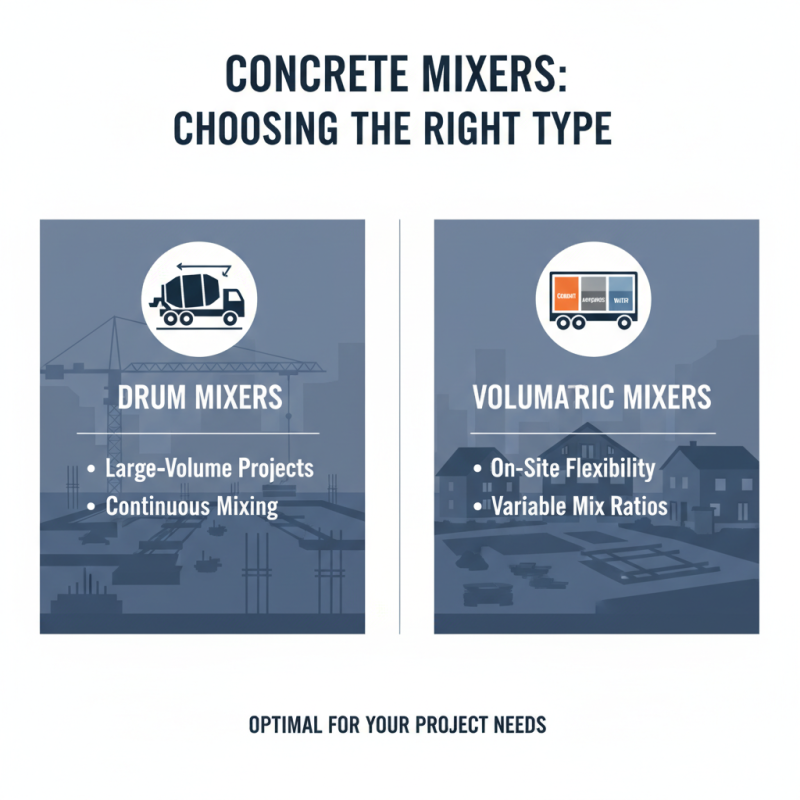
Choosing the right concrete mixer truck is crucial for your projects. Understanding the different types can simplify this decision. There are drum mixers, which mix the concrete in a rotating drum. They are optimal for large volume projects. Another option is the volumetric mixer. It allows flexibility in mixing on-site. This is ideal for projects with varying concrete needs.

Tips for choosing a mixer include assessing your project size. Smaller jobs may not require a large drum mixer. Consider the loading and unloading method. A truck with a better design can save time on-site. Weather conditions also play a role. In rainy weather, a covered mixer might be preferable.

Remember, not all mixers are the same. Some might not perform well with specific concrete types. Research different mixers thoroughly. Look for user reviews and practical demonstrations. Ensure that the truck you choose meets your volume and type requirements effectively. Always ask questions before making a final decision. Having the right equipment sets the stage for success in any construction task.

Key Specifications and Features of Concrete Mixer Trucks

When choosing a concrete mixer truck, key specifications and features play a crucial role. The capacity of the drum is vital. Larger drums can carry more concrete. This is essential for bigger projects, where efficiency is key. Pay attention to the mixing technology. Different mixers provide varying efficiency levels. A reliable mixer ensures a consistent mix, which affects the quality of your work.

Another important feature is the truck's maneuverability. A truck that is easier to maneuver can save time on job sites. Consider models with advanced steering systems. These systems can significantly enhance control in tight spaces. Additionally, fuel efficiency is a major factor. An efficient truck reduces operational costs over time. Every bit of savings counts, especially on large-scale projects.

Don't overlook the durability of materials used in the truck’s construction. A durable mixer withstands tough conditions. However, consider maintenance needs as well. Some models require more frequent repairs than others. This can impact your overall budget and project timelines. Reflecting on these aspects can help identify your best fit. A well-informed choice leads to better outcomes in the long run.

Concrete Mixer Truck Specifications Comparison

Evaluating Capacity and Load Requirements for Your Projects

When choosing a concrete mixer truck, evaluating capacity and load requirements is crucial. Each project has specific needs, from small residential pours to large commercial jobs. Understanding the volume of concrete required helps in selecting the right mixer size. A truck that is too small may lead to delays and excess trips. Conversely, an oversized mixer could increase costs unnecessarily.

Consider the maximum load capacity of the truck. This should match the specifications of your project. For example, an average truck can carry about 8 to 10 cubic yards of concrete. If a project requires 25 cubic yards, you may need multiple trips or mixers. Think about the time efficiency and labor costs involved.

Moreover, be aware of your project's site conditions. Tight spaces may limit the types of trucks you can use. An overly large truck could struggle to maneuver. Evaluating site access can prevent complications during the pour. Taking these factors into account will lead to a smoother operation and potentially better outcomes.

How to Choose the Best Concrete Mixer Truck for Your Needs? - Evaluating Capacity and Load Requirements for Your Projects

Truck Model Capacity (Cubic Yards) Load Weight (lbs) Engine Power (HP) Fuel Type Price Range ($)
Model A 10 20,000 300 Diesel $150,000 - $180,000
Model B 8 16,000 280 Gasoline $120,000 - $150,000
Model C 12 24,000 400 Diesel $180,000 - $220,000
Model D 6 12,000 250 Gasoline $100,000 - $130,000

Cost Analysis and Budgeting for a Concrete Mixer Truck Purchase

When planning to purchase a concrete mixer truck, cost analysis is crucial. The initial price is important, but hidden costs can add up. Maintenance, fuel efficiency, and insurance should be carefully considered. Sometimes, a lower upfront cost leads to higher operational costs. This highlights the importance of performing a total cost of ownership analysis.

Budgeting for a concrete mixer truck requires a clear understanding of your project's needs. Look beyond just the truck itself. Factor in the costs for mixing technology and after-sales service. These can significantly influence long-term satisfaction and productivity. It is wise to compare different models and their specifications. Choosing the right features can prevent overspending on unnecessary options.

Reflecting on personal experiences can provide valuable insights. Some buyers rush into decisions, overlooking potential expenses. Setting a realistic budget helps avoid making hasty choices. Tight budgets may limit options, but they can encourage more thoughtful decision-making. Prioritizing essential features over luxury items often leads to a more suitable purchase. A careful, informed approach is vital to ensure lasting value and efficiency.