
If you are interested in financing to fund your Bay-Lynx purchase, we recommend that you connect with Easylease Corp., a Canadian-based leasing and finance company that offers premier equipment leasing and financial services. They are focused on making it easier than ever before for companies to overcome cash flow and resource constraints to acquire the assets they need to grow their business.
Leasing through Easylease Corp. can offer several benefits:
Click here for your Canadian instant lease quote >>
For US customers, Click here for your instant lease application >>
Choosing the right Air Compressor can significantly impact productivity and efficiency in various applications. The global air compressor market is projected to reach $37.2 billion by 2027, according to Market Research Future. This staggering growth reflects the importance of air compressors across industries such as construction, automotive, and manufacturing.
Understanding your specific needs is vital. Different air compressors offer diverse features and capabilities. For instance, a stationary model may suit a factory's high-volume requirements, while a portable option is ideal for smaller, mobile tasks. Industry reports indicate that improper selection can lead to inefficiencies and increased operational costs.
Moreover, consumers often overlook crucial details. Air pressure, CFM ratings, and tank size should align with intended usage. Neglecting these factors might result in underperformance or overinvestment. Ultimately, an informed choice enhances reliability and effectiveness, ensuring that the air compressor meets your unique demands.
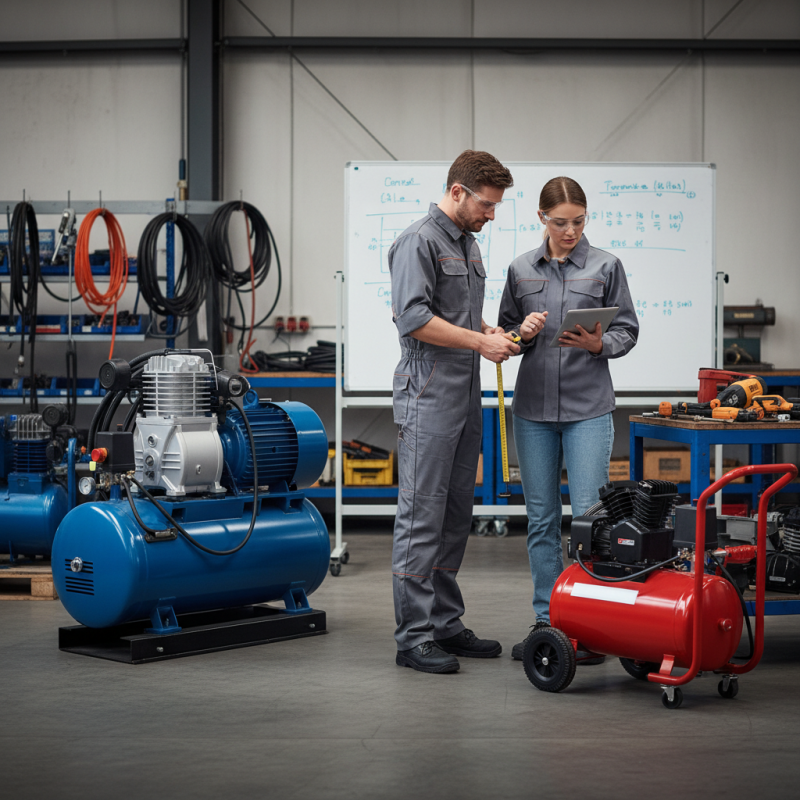
When selecting an air compressor, understanding the different types is crucial. There are three main types: reciprocating, rotary screw, and centrifugal compressors. Each type serves unique purposes. Reciprocating compressors are common for small-scale tasks, like inflating tires or powering nail guns. They are efficient but can be noisy.
Rotary screw compressors are ideal for larger applications. They provide continuous air supply, making them suitable for workshops or factories. However, their complexity can lead to higher maintenance needs. Centrifugal compressors handle large volumes of air and are often used in industrial settings. They are efficient but generally more expensive to install.
Choosing the right air compressor requires reflection on your specific needs. Think about the volume of air you need and the pressure required. Assess your workspace's noise tolerance as well. Different tasks may demand different types of compressors. It's essential to weigh the pros and cons of each type carefully. This ensures the best fit for your requirements, allowing you to work efficiently without overspending.
When selecting an air compressor, key specifications play a vital role. Understanding these can greatly affect your choice. Pressure is critical. Most tools require specific pressure to function efficiently. Commonly, a compressor should deliver at least 90 PSI for typical applications. Reports indicate that mismatch in pressure can lead to poor performance and excessive wear.
Additionally, consider the compressor's tank size. A larger tank helps maintain steady pressure during operation. For instance, a 20-gallon tank can keep up with pneumatic tools for longer periods. Industry studies show that users often underestimate the importance of tank size, leading to interruptions and reduced productivity.
Another relevant factor is flow rate, measured in CFM (cubic feet per minute). For continuous operation, a higher CFM rating is essential. Tools like spray guns or nailers require different flow rates. Experts recommend calculating your tools' combined CFM needs to ensure efficiency. Many users fail to account for this detail, resulting in inadequate performance. Focus on these elements to make a more informed choice.
When choosing an air compressor, understanding CFM and PSI is crucial. CFM stands for Cubic Feet per Minute, measuring airflow. PSI, or Pounds per Square Inch, gauges pressure. Both are vital for performance, but often confusing.
For instance, a pneumatic tool might need 4 CFM at 90 PSI. A typical air compressor can deliver these values, but it's essential to match them with your equipment's requirements. Many industry reports suggest that tools requiring a higher CFM and PSI will demand a more powerful compressor. Neglecting these specifications leads to inefficient performance.
Users sometimes overlook their requirements. They may purchase too small a unit, causing frustration and wasted resources. A compressor delivering 2 CFM at 90 PSI may seem adequate, yet it might not handle continuous usage well. Evaluating your true needs before a purchase is critical for efficiency and productivity.
When choosing an air compressor, portability and stationary models cater to different needs. Portable compressors are lightweight and easy to move. They are ideal for contractors or those who require flexibility. With wheels and handles, these compressors can be taken to various job sites. However, they may lack the power for heavy-duty tasks.
On the other hand, stationary compressors offer more power and capacity. They are suited for fixed locations like workshops or garages. These models are great for larger tools and continuous use. A downside is their immobility; once set up, they remain in place. This can limit versatility, especially if your projects frequently change.
Evaluating your workspace is essential. Consider storage space and noise levels. A portable unit may be quiet enough for residential areas, while a stationary model could be more disruptive. Think about your specific requirements and how each option aligns with your goals. Sometimes, compromising on portability for power is necessary. Reflect on how often you will use the compressor and for what tasks. This thought process can guide you to the right choice.
| Model Type | Portability | Typical Use | Power Source | Tank Size (Gallons) | Max Pressure (PSI) | Weight (lbs) |
|---|---|---|---|---|---|---|
| Portable | Yes | Home use, DIY projects | Electric | 1.5 | 120 | 30 |
| Stationary | No | Professional workshops | Electric | 20 | 150 | 200 |
| Portable | Yes | Tire inflation, small tools | Gas | 3.5 | 90 | 40 |
| Stationary | No | Heavy equipment, manufacturing | Electric | 60 | 175 | 400 |
When budgeting for an air compressor, initial costs must be weighed against long-term value. The purchase price can range from several hundred to several thousand dollars. Choosing the right compressor means considering how often it will be used and for what purposes. A report from the U.S. Department of Energy indicates that energy efficiency can significantly impact operating costs over time. For example, a unit that uses less electricity may save approximately 20-30% annually on energy bills.
Tips: Consider units with higher energy efficiency ratings. Look for certified models to ensure reliability.
Maintenance costs also play a crucial role. Some air compressors require regular oil changes and filter replacements, which can add to long-term expenses. Research shows that neglecting maintenance can reduce a compressor's lifespan by 50%. Investing in a quality model that requires minimal upkeep can be more cost-effective in the long run.
Tips: Always factor in maintenance when choosing a compressor. Budget for spare parts and repairs.
Lastly, consider depreciation. While most compressors last for over ten years, their value diminishes. A compressor with better technology may retain its value longer. Ultimately, you want to choose an air compressor that offers functionality and efficiency, aligning costs with your needs.