
If you are interested in financing to fund your Bay-Lynx purchase, we recommend that you connect with Easylease Corp., a Canadian-based leasing and finance company that offers premier equipment leasing and financial services. They are focused on making it easier than ever before for companies to overcome cash flow and resource constraints to acquire the assets they need to grow their business.
Leasing through Easylease Corp. can offer several benefits:
Click here for your Canadian instant lease quote >>
For US customers, Click here for your instant lease application >>
Buying Heavy-Duty Pallet Racks in China can give warehouse operators access to a wide range of storage systems and suppliers. The harder question is not simply where to find a low price. It is how to confirm that a rack suits your loads, forklifts, building layout, and daily workflow. A beam that looks substantial in a catalog still needs a clearly stated capacity. Details matter.
Potential sources include rack manufacturers, sourcing companies, and established industrial marketplaces. Each has trade-offs. A direct factory may offer closer design communication, while an intermediary may help coordinate quotes and shipping. Neither option guarantees quality by itself. Ask for drawings, material specifications, load ratings, and product-specific test records. Confirm whether the quoted system includes beams, uprights, braces, anchors, and installation guidance. Missing components can change the real cost.
Before placing an order, compare suppliers using the same rack dimensions and loading requirements. Request recent production photos, sample inspection records, and references for similar projects. If the order is substantial, consider an independent pre-shipment inspection. Check weld consistency, coating coverage, hole alignment, and packaging. These are practical details, not paperwork for its own sake. A polished catalog can still leave questions unanswered. That is easy to overlook. This guide explains where buyers can search in China and how to assess suppliers with care, so price, product evidence, and warehouse needs stay in view.
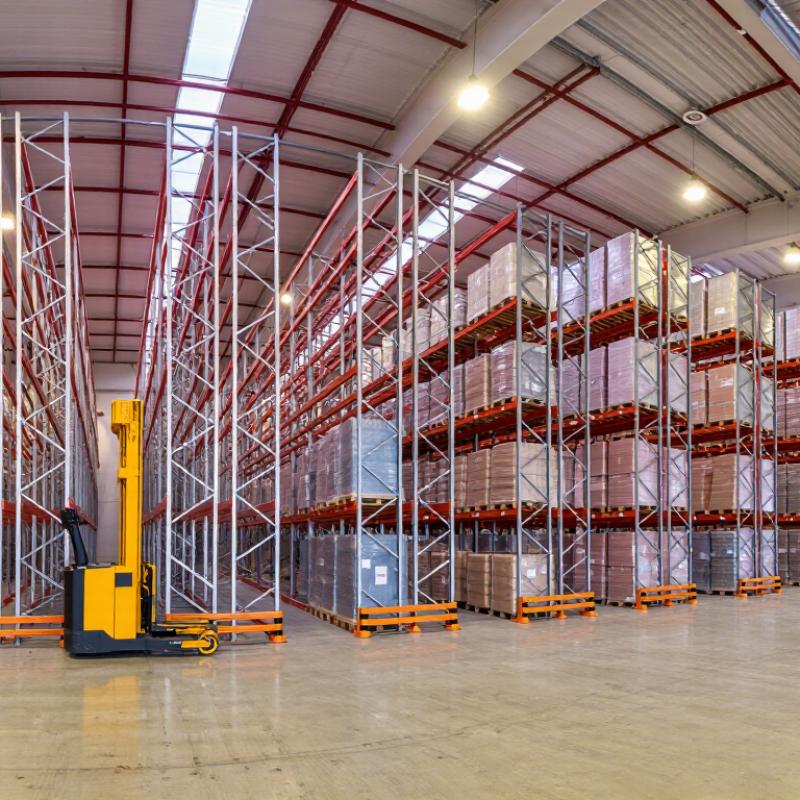
To source heavy-duty pallet racks in China, compare factories by engineering depth, not just price. Established manufacturing clusters in Jiangsu, Zhejiang, Guangdong, and Hebei offer many suppliers, but location alone proves little. The China Federation of Logistics and Purchasing reported that China’s total social logistics value reached 352.4 trillion yuan in 2023, up 5.2% year over year. That scale points to strong demand for storage infrastructure, not automatic quality.
Ask each shortlisted factory for steel specifications, load-test records, rack drawings, and a clear explanation of rated capacity per beam level. Check weld consistency, upright perforations, bracing, and coating on a physical sample. Request a third-party factory inspection before production, and confirm that the proposed layout matches your pallet dimensions and forklift aisle needs. Small details matter.
MHI’s 2024 Annual Industry Report, based on a survey of more than 1,000 supply-chain professionals, found that 55% planned to increase technology investment. For buyers, that makes compatibility with warehouse systems worth discussing early. Compare quotations on the same specifications, delivery terms, and packing method. A low quote can hide thinner steel or missing safeguards. I would still verify every load figure independently; paperwork can look polished while leaving gaps.
| Sourcing route | Best suited for | What to verify | Key purchasing considerations |
|---|---|---|---|
| Direct from a manufacturer | Large projects, repeat orders, or systems requiring custom dimensions and layouts. | Factory identity and production capability; material specifications; drawings; load calculations; quality-control records; and whether installation support is available. | Compare complete project quotations, not just the price per frame or beam. Confirm packaging, export terms, spare parts, and responsibility for engineering and installation. |
| Business-to-business sourcing platform | Buyers who want to compare multiple suppliers remotely or begin with a request for quotation. | Whether the listed seller is the manufacturer or a trading company; business registration; product documentation; sample or inspection options; and the scope of any platform protections. | Treat online listings as a starting point. Independently confirm specifications, payment terms, production schedule, inspection arrangements, and the legal contracting entity. |
| Independent sourcing or procurement agent | Buyers who need local communication, supplier comparisons, factory visits, or coordination across several vendors. | Written scope of work; fee structure; supplier relationships; inspection independence; reporting method; and who holds responsibility for technical approvals. | Clarify whether the agent represents the buyer or receives compensation from suppliers. Keep final technical approval and purchase terms in the buyer’s contract. |
| Local distributor or warehouse-equipment integrator | Projects that benefit from local stock, site measurement, installation, or after-sales service in the destination market. | Local service coverage; installation qualifications; product origin and documentation; warranty terms; and availability of compatible replacement components. | The purchase price may include local services and support. Compare the full delivered and installed scope with a direct-import quotation. |
| Trade fair or industry exhibition | Buyers who want to inspect samples, discuss project requirements in person, and meet several suppliers during one trip. | Whether the exhibitor manufactures the proposed system; technical staff availability; product test or design documents; and post-event quotation and follow-up. | An exhibition meeting is not a substitute for due diligence. Request a written specification and independently verify the factory and project references. |
| Used-rack supplier or liquidation channel | Projects with a tight budget where the buyer can accept limited configuration choices and arrange careful inspection. | Component condition; damage, corrosion, repairs, missing parts, and system compatibility; original load information; and whether the proposed layout can be safely re-engineered. | Do not assume used components retain their original capacity. Have a competent rack designer assess condition and suitability before purchase or use. |
| Check | Information to request or confirm |
|---|---|
| Load design | Provide pallet dimensions, maximum unit load, beam levels, bay configuration, and the required system layout. Request design calculations and clearly stated beam and frame capacities for that specific configuration. Capacity depends on design, dimensions, materials, and installation conditions. |
| Drawings and site conditions | Confirm clear heights, aisle widths, floor condition and capacity, building obstructions, seismic requirements where applicable, forklift type, and required clearances. Obtain approval drawings before production. |
| Applicable standards | Specify the standards required by the project and destination market. For projects using European guidance, ask about the applicable editions of EN 15512 (structural design), EN 15620 (tolerances, deformations, and clearances), EN 15629 (specification), and EN 15635 (application and maintenance). Confirm applicability with the project’s qualified designer; these standards do not automatically apply to every project. |
| Materials and finish | Request material grades and thicknesses for structural components, coating or finish details, corrosion-protection requirements, and inspection records. Match the finish to the indoor or outdoor environment specified for the project. |
| Inspection and acceptance | Agree on pre-shipment inspection, component identification, packing lists, quantity checks, and the procedure for documenting nonconforming goods. For large orders, consider an independent inspection against the approved drawings and purchase specification. |
| Shipping and total cost | Compare product price with packaging, inland transport, export documentation, freight, insurance, customs duties, taxes, unloading, installation, and any local compliance costs. State the delivery term, destination, schedule, payment milestones, and warranty conditions in the contract. |
| Installation and ongoing safety | Confirm who is responsible for installation, anchoring, handover, and operating instructions. Plan regular inspections and promptly assess damaged components; do not change the configuration or use a rack beyond its approved design capacity. |
Note: This comparison is a sourcing guide, not a supplier endorsement. Final rack selection, capacity, and installation should be based on project-specific engineering and applicable local requirements.
