If you are interested in financing to fund your Bay-Lynx purchase, we recommend that you connect with Easylease Corp., a Canadian-based leasing and finance company that offers premier equipment leasing and financial services. They are focused on making it easier than ever before for companies to overcome cash flow and resource constraints to acquire the assets they need to grow their business.
Leasing through Easylease Corp. can offer several benefits:
Click here for your Canadian instant lease quote >>
For US customers, Click here for your instant lease application >>
In the ever-evolving construction industry, the mobile concrete mixer has emerged as a vital tool. According to the latest report from MarketsandMarkets, the mobile concrete mixer market is projected to grow at a CAGR of 6.2% by 2026. This growth signifies a push towards more efficient and flexible construction operations. Industry expert David Johnson states, "The mobile concrete mixer has transformed the way we approach small to medium-sized projects."
Contractors increasingly rely on mobile concrete mixers for their ability to provide on-site mixing. This adaptability saves time and reduces transportation costs for concrete. However, choosing the right model can be challenging. Many mixers available today come with varied features and capacities. Therefore, understanding the operational requirements is crucial.
Despite the advantages, some users report difficulties with maintenance and operational training. It’s essential to evaluate what truly suits your needs. Many buyers rush into purchases without adequate research, leading to dissatisfaction later. As you consider investing, be mindful of both the potential and the challenges associated with mobile concrete mixers.
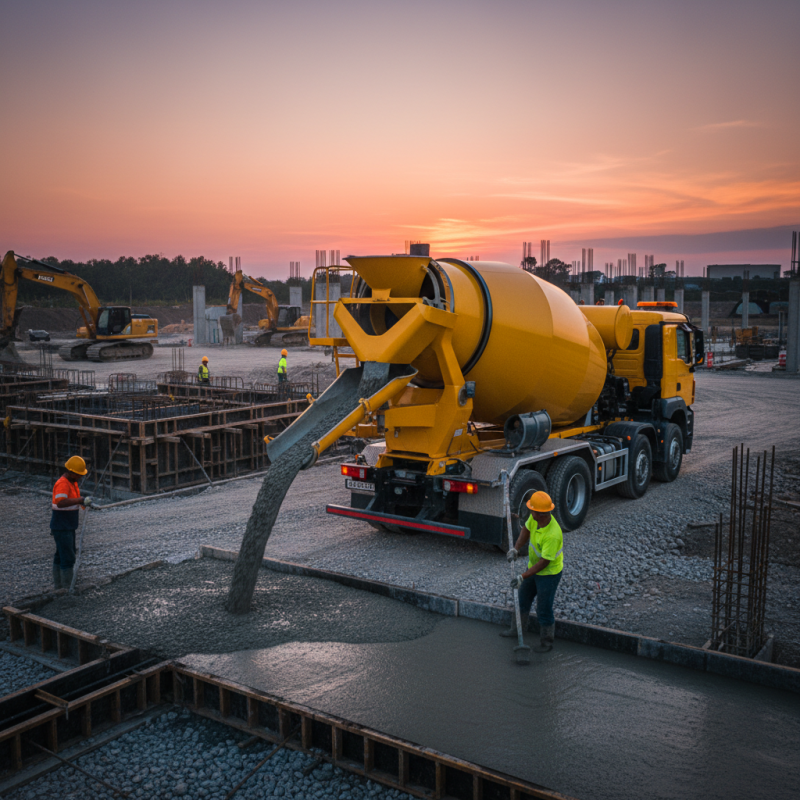
When considering mobile concrete mixers, several key features set them apart. Portability is a significant advantage. Many construction projects require flexibility. A mobile mixer can easily transition from one site to another. This adaptability allows for real-time mixing. It meets the varying demands of different projects.
Efficiency is another critical factor. Reports indicate that productivity can increase by up to 30% with mobile mixers. These machines reduce the waiting time for concrete. On-site mixing minimizes delays. Workers can achieve faster setups and quicker pours. However, some units may struggle in challenging terrains.
Additionally, the customizable options on mobile mixers offer benefits. Users can adjust the batch sizes. This feature is vital for projects of different scales. Yet, managing these customizations might be complex for inexperienced operators. Regular training and maintenance are crucial. These steps ensure optimal performance. Mistakes in mixing proportions can lead to project setbacks. Ensuring accuracy is essential for structural integrity.
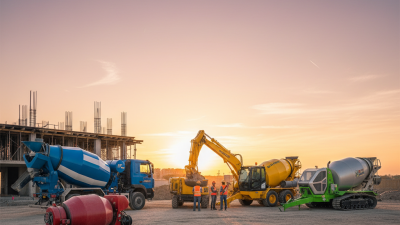
Mobile concrete mixers come in various types, each designed to meet specific needs. Choosing the right one is crucial for construction efficiency. For small projects, a towable mixer is often ideal. These mixers are easy to transport and operate. They are suitable for mixing small batches of concrete on-site.
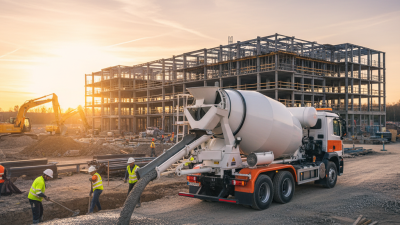
On the other hand, larger projects benefit from truck-mounted mixers. These machines can handle substantial volumes of concrete while remaining mobile. However, their maintenance can be more complex than smaller options. Make sure you weigh the pros and cons carefully before investing in a mixer type.
**Tip:** Always consider your project's size before making a decision. A mixer might seem perfect but could be impractical for your needs.
Another factor to evaluate is the ease of use. Some models are more user-friendly than others. This can significantly affect work productivity.
**Tip:** Don’t hesitate to ask for demonstrations. Testing the equipment can reveal hidden challenges. Reading user reviews also provides valuable insights into the performance of different mixers.
In 2026, mobile concrete mixers have evolved to meet diverse construction needs. They blend aggregate, cement, and water efficiently. These machines provide convenience on-site and save time. Compact size makes them easier to transport. However, selecting the right model can be challenging.
Reading detailed reviews is essential. Users often praise the ease of use but note maintenance can be tedious. Several models have unique features, like digital controls or adjustable mixing speeds. It’s vital to weigh these benefits against potential drawbacks. Some users reported issues with durability, particularly in extreme conditions.
Portability is a key factor in 2026 models. Lightweight designs enhance mobility, but they may compromise stability. A careful assessment of the construction environment is necessary. Investing in a mixer requires reflection on your project's needs. Users should consider factors like output capacity and mixing efficiency. Consideration of these elements will lead to informed choices.
When choosing a mobile concrete mixer, consider capacity first. Mixers come in various sizes. A smaller unit may suit home projects. Larger tasks need bigger mixers. Think about the volume of concrete you'll require. This will help avoid overloading the machine.
Mobility features are crucial. How easy is it to transport? Look for sturdy wheels and a reliable hitch. Some mixers are lightweight, ensuring easy movement. Others may be bulkier but more powerful. Balance convenience and strength.
Pay attention to mixing efficiency as well. Look for machines with optimal drum shapes. This can enhance blend quality. Check user reviews to learn about performance. Every mixer has strengths and weaknesses. Understanding these will guide your choice. Don't ignore maintenance aspects either. Some mixers require more upkeep than others. Choose one that fits your comfort level with maintenance.
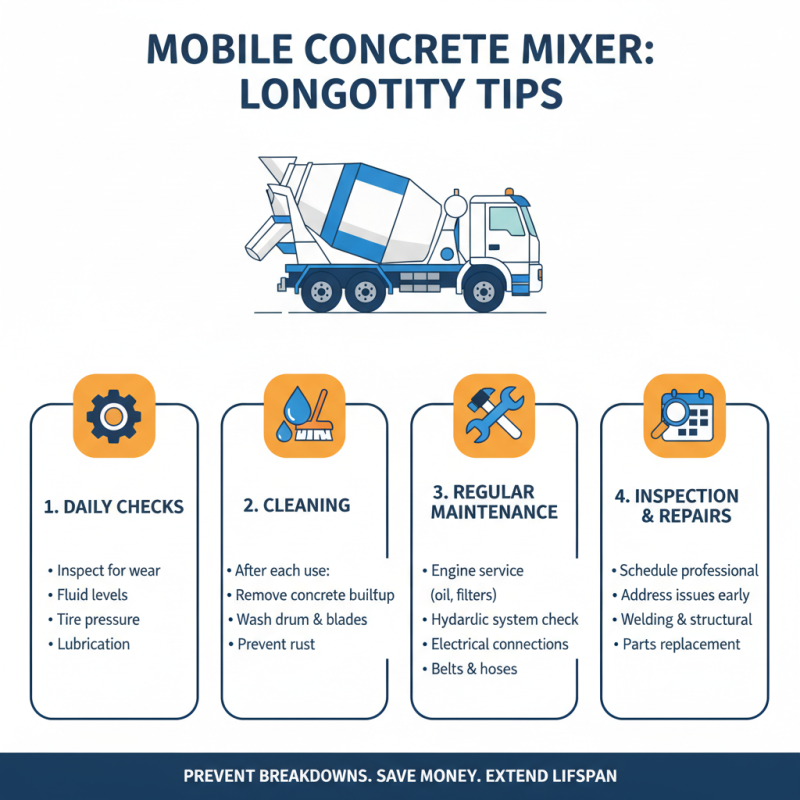
Maintaining a mobile concrete mixer is essential for its longevity. Regular upkeep can prevent breakdowns and costly repairs. Here are some tips to ensure your equipment stays in shape for years.
Check the hydraulic oil levels regularly. Low oil can lead to serious issues. Replace filters as per the manufacturer's schedule. Clean the mixer after each use to avoid buildup of concrete residue. A clean mixer operates more efficiently, which saves time and effort.
Pay attention to the tires. Inspect them frequently for wear and proper inflation. Worn tires can affect mixing quality and safety. Don’t neglect the battery either. Ensure connections are clean and tight. If the mixer sits unused for long periods, consider a maintenance charge. These small actions can make a difference.