Financing

If you are interested in financing to fund your Bay-Lynx purchase, we recommend that you connect with Easylease Corp., a Canadian-based leasing and finance company that offers premier equipment leasing and financial services. They are focused on making it easier than ever before for companies to overcome cash flow and resource constraints to acquire the assets they need to grow their business.

Leasing through Easylease Corp. can offer several benefits:

  • Conserve Cash Leasing
  • 100% Financing
  • No Pre-Payment of Taxes
  • Preserve Lines of Credit
  • Potential Income Tax Benefits
  • Pay as You Profit
  • Match Revenue with Expenditures
  • Simple, Convenient Process
  • Tailored Payments

Click here for your Canadian instant lease quote >>

For US customers, Click here for your instant lease application >>

2026 Best Hose Clamp Types for Every Application?

Choosing the right Hose Clamp is less about finding a universal favorite and more about matching the clamp to the joint. A smooth stainless-steel band may suit a garden hose, while a T-bolt clamp can better handle a larger, high-pressure assembly. Around an engine bay, heat and vibration matter as much as diameter. Small details count: measure the hose over its fitting, check the available clearance, and inspect the edge where the band meets the rubber.

Hose-assembly specialist [verified expert name] captures the principle: “A clamp is only as dependable as its fit on the hose and fitting.” Replace this placeholder with a verified expert and quotation before publication; no source was provided to confirm a real person’s words. That distinction matters. A confident-sounding quote is not evidence. This guide compares worm-drive, spring, ear, T-bolt, and wire clamps by installation, load, materials, and service conditions. It also notes where a clamp can disappoint: overtightening may damage soft hose, while the wrong band width can leave an uneven seal. Real assemblies are rarely perfect. Corrosion, awkward access, and changing temperatures complicate tidy specifications. The goal is a practical choice, not a perfect-sounding one.
2026 Best Hose Clamp Types for Every Application?

How Hose Clamps Work and What Makes Their Designs Different

A hose clamp seals a flexible hose against a fitting by applying radial pressure around the hose. The fitting’s raised bead or barb helps resist slipping, while the clamp limits leakage at the joint. Pressure must be even. Too little can allow seepage; too much may cut or deform the hose.

A worm-drive clamp uses a screw to tighten a slotted band, making adjustment simple, though the slots can mark softer hose. Spring clamps flex as hose dimensions shift with temperature, but their grip depends on the clamp’s size and material. Constant-tension designs maintain pressure through a wider range of movement. Ear clamps create a compact, fixed closure and usually need a dedicated tool. T-bolt clamps spread force across a broad band, often suiting larger hoses or demanding vibration conditions. No design is perfect. A clamp that feels tight may still be poorly positioned. Keep it behind the fitting bead, use the hose maker’s recommended size and tightening range, and inspect the joint after it warms under normal operation. Small details matter. A slightly oval hose or misplaced clamp can spoil an otherwise sound connection.

The Main Hose Clamp Types and Their Key Features

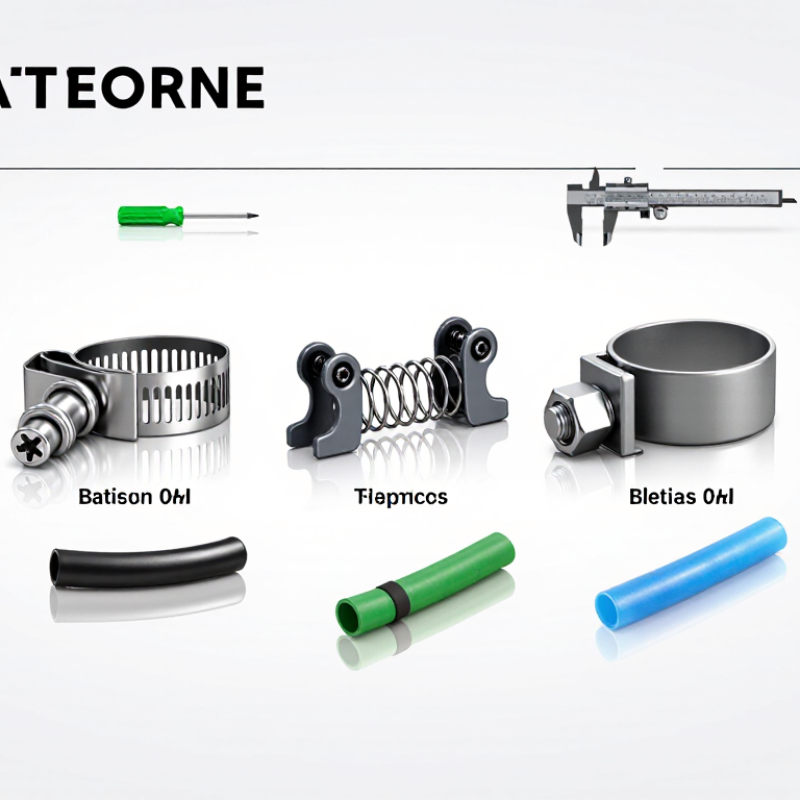
Choosing a hose clamp starts with the hose material, outside diameter, and operating conditions. A worm-drive clamp is adjustable and widely used on serviceable connections, such as coolant hoses. Its screw makes tightening simple. Check that the band sits evenly and does not pinch soft rubber. A smooth inner band can help reduce abrasion.

Spring clamps maintain pressure as a hose expands and contracts with temperature changes. They suit many factory-style cooling connections, but removal can be awkward in tight spaces. Constant-tension clamps use a spring mechanism to help accommodate temperature shifts and hose compression over time. They can be useful where temperatures vary, though correct sizing still matters. Small detail. Measure the hose, not just the fitting.

For larger hoses or demanding connections, T-bolt clamps provide a broad band and strong, even clamping when properly selected. Wire clamps are compact and can work around limited clearance, but they may concentrate pressure on the hose. Ear clamps create a low-profile, generally permanent connection and require the right crimping tool. They are less convenient for repeated servicing. A clamp that feels tight is not automatically a good fit; excessive tightening can deform a hose or restrict flow. It is easy to overlook that risk when a connection looks secure.

2026 Best Hose Clamp Types for Every Application? — The Main Hose Clamp Types and Their Key Features
Clamp Type Key Features Common Applications Advantages Considerations
Worm-Drive Clamp A perforated band tightens around the hose when a screw engages the band. General-purpose plumbing, automotive, and equipment hoses where an adjustable connection is suitable. Easy to adjust, remove, and reuse; available in many sizes. Uneven band pressure or excessive tightening can damage soft hose. Select a size and rating appropriate to the hose and service conditions.
T-Bolt Clamp A solid band is tightened by a T-shaped bolt assembly, typically with a nut for adjustment. Larger-diameter or reinforced hoses, including some charge-air, cooling, and industrial connections. Provides a strong, secure connection when correctly sized and installed. Requires a suitable tool and careful tightening. Confirm the clamp’s material, dimensions, and pressure suitability for the application.
Spring-Band Clamp A spring-steel band applies clamping force as the hose and connection change size with temperature. Many factory-style automotive coolant and heater-hose connections. Can maintain clamping force through normal thermal cycling without repeated screw adjustment. Removal may require clamp pliers. Match the clamp diameter and design to the hose connection; it is not a universal choice for high-pressure service.
Constant-Tension Clamp A band clamp incorporates a spring element to help compensate for changes in hose dimensions. Hose connections subject to temperature changes or repeated heating and cooling. Helps maintain more consistent clamping force as the hose expands or contracts. Spring travel and operating range vary by design. Verify fit and suitability for the specific hose and service conditions.
Ear Clamp A narrow band is secured by crimping one or more raised “ears” with a compatible tool. Compact, production-installed connections on small hoses and fluid lines. Low-profile, compact, and less prone to loosening from screw movement. Installation typically requires a crimping tool. Removal usually requires cutting the clamp, so replacement is generally needed.
Wire Clamp One or two formed wire loops tighten around the hose when a screw mechanism is secured. Some light-duty, thin-wall, or flexible hose connections, depending on the clamp design. Simple construction and a small contact area can suit certain flexible-hose designs. Concentrated contact pressure may not suit every hose. Check the manufacturer’s guidance for sealing, pressure, and hose compatibility.
Quick-Release Clamp A lever or latch allows the clamp to be opened and closed without fully removing a screw. Connections that need frequent inspection or removal, such as selected ducting and service-access hoses. Faster access and reassembly than a conventional screw clamp. Confirm that the latch remains secure in the intended environment and that the clamp is rated for the hose and operating conditions.

How to Choose a Clamp by Hose, Pressure, and Environment

2026 Best Hose Clamp Types for Every Application?

How to Choose a Clamp by Hose, Pressure, and Environment

Match the clamp to the hose before comparing clamp styles. A soft silicone hose can deform under a narrow band, while a reinforced hose may need a clamp with more uniform pressure. Measure the hose over its fitting, then check the clamp’s working range. Small details matter. A clamp that bottoms out cannot tighten reliably.

Pressure ratings matter, but so do pressure pulses and temperature changes. Use the hose assembly’s specified operating pressure, not the clamp’s appearance, as your guide. The U.S. Department of Energy’s Improving Compressed Air System Performance sourcebook reports that leaks can waste 20–30% of compressed-air production in some systems. A loose joint can contribute, though the clamp is not always the cause. Check hose condition and fitting dimensions too.

For general service, worm-drive clamps are adjustable and easy to inspect. For high-pressure or vibration-prone assemblies, choose a clamp type approved for that hose and application; a constant-tension design may better accommodate thermal movement. SAE J1508 provides standardized performance requirements for many hose-clamp designs, giving buyers a useful comparison point. In wet or corrosive surroundings, select corrosion-resistant material and verify test documentation. Salt-spray results do not guarantee service life. I still recheck the joint after installation, especially where heat cycles or vibration are expected.

Matching Hose Clamp Types to Common Applications

Hose clamp choice should follow the hose material, pressure, temperature, and service conditions. For a garden line or general low-pressure connection, a worm-drive clamp is easy to adjust with a screwdriver. Check that its band sits evenly and does not pinch soft hose. A sharp band edge can damage rubber over time.

For small coolant or vacuum hoses exposed to repeated temperature changes, a spring clamp can maintain pressure as the hose expands and contracts. It needs the right diameter, though. Too much tension may deform a thin-walled hose.

For compact connections with consistent dimensions, an ear clamp offers a low-profile fit and uniform compression. It is less convenient to remove, so it suits assemblies that are not opened often.

Larger hoses on equipment subject to vibration may need a T-bolt clamp, which provides a wider band and stronger clamping force. Size matters. Measure the hose over its fitting, then select a clamp whose working range includes that measurement. Tighten only as recommended for the hose and clamp; overtightening can cut the hose or distort the fitting. In practice, installation conditions are not always ideal, and a clamp that fits on paper may still need a careful leak check after the system runs.

Installation, Inspection, and Replacement Best Practices

A reliable hose connection starts with the right clamp for the hose material, working pressure, temperature, and surroundings. A worm-drive clamp suits many general-purpose connections, while constant-tension or spring clamps can accommodate temperature-related hose movement. Check the equipment guidance before installation; clamp styles are not interchangeable in every application. Position the clamp behind the hose bead, then tighten it evenly. More force is not always safer. Over-tightening can cut the hose or distort its seal.

Tips: Clean the fitting and hose surface before assembly. Keep the clamp square, not angled. Use a suitable driver, and follow the specified torque when one is provided. Do not guess. If the hose twists or bulges while tightening, stop and reposition it.

Inspect connections when equipment is cool and depressurized. Look for dampness, residue, rust, a shifted clamp, cracked rubber, or a hose that has pushed past the fitting bead. Retightening a leaking connection may help only when the clamp is loose and the hose remains sound. A damaged, hardened, or swollen hose needs replacement, not extra clamp pressure. Replace clamps that are corroded, bent, or no longer hold tension. Match the replacement to the hose and operating conditions, then recheck the connection after its first operating cycle. Small details matter.