
Financing

If you are interested in financing to fund your Bay-Lynx purchase, we recommend that you connect with Easylease Corp., a Canadian-based leasing and finance company that offers premier equipment leasing and financial services. They are focused on making it easier than ever before for companies to overcome cash flow and resource constraints to acquire the assets they need to grow their business.

Leasing through Easylease Corp. can offer several benefits:

  • Conserve Cash Leasing
  • 100% Financing
  • No Pre-Payment of Taxes
  • Preserve Lines of Credit
  • Potential Income Tax Benefits
  • Pay as You Profit
  • Match Revenue with Expenditures
  • Simple, Convenient Process
  • Tailored Payments

Click here for your Canadian instant lease quote >>

For US customers, Click here for your instant lease application >>

7 Best Flying Inflatable Boats for Buyers in 2026

Choosing a Flying Inflatable Boat calls for more than comparing speed claims and glossy photos. Buyers need to understand how the craft handles on water, during takeoff, and in changing weather. Payload, hull materials, inflation time, engine support, and storage dimensions can matter more than a headline specification. The category is unusual. That makes careful verification especially important.

The National Marine Manufacturers Association’s 2024 economic-impact report estimates that U.S. recreational boating contributes about $230 billion to the economy and supports roughly 812,000 jobs. Those figures show boating’s scale, but they do not measure demand for flying inflatable craft specifically. The FAA’s Aerospace Forecast for fiscal years 2025–2045 offers broader context on general aviation activity; it does not rank inflatable flying boats. A useful distinction.

This guide compares seven options for buyers in 2026, focusing on published specifications, practical ownership considerations, and the evidence behind each manufacturer’s claims. Look closely at usable payload, assembled dimensions, propulsion compatibility, maintenance needs, and how performance figures were measured. A short takeoff claim, for example, means little without the stated load and test conditions. Manufacturer data is not the same as independent testing. Where public evidence is limited, that uncertainty deserves attention—not guesswork. The best choice is the one that fits your intended use, storage space, experience, and realistic operating conditions.
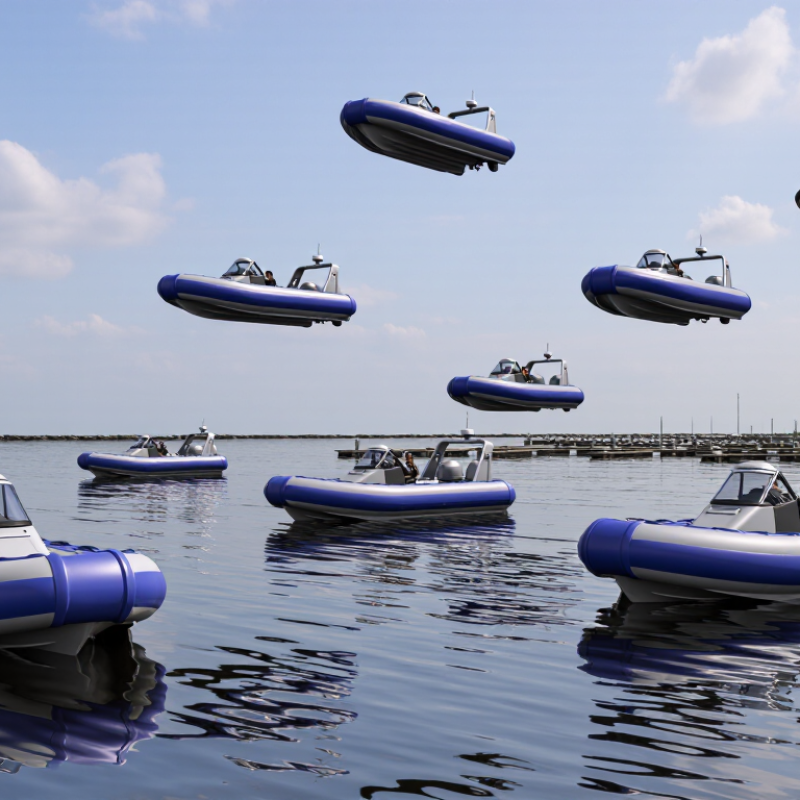
7 Best Flying Inflatable Boats for Buyers in 2026

Flying Inflatable Boats Defined: Hull, Wing, and Propulsion Configurations

A flying inflatable boat combines a buoyant tube hull with a fabric wing and motor-driven propeller. The hull carries the craft over water; the wing supplies lift after airflow builds. This is not a conventional seaplane. Buyers should check whether the design uses a flat inflatable floor, rigid panels, or a keel that shapes the ride. Small details matter. Tube diameter, floor stiffness, and load placement can change handling, especially when a passenger shifts weight.

Wing and propulsion layouts vary. A flexible overhead wing is common, while the motor may drive a rear-mounted pusher propeller or a forward tractor propeller. The pusher arrangement keeps the propeller behind occupants, but it can complicate inspection and access. Ask how the wing is packed, attached, and controlled, and whether the motor’s rated output matches the loaded craft. There is no universal “best” setup. A light hull may launch readily, yet feel less forgiving in choppy water.

Safety data deserves attention, too. The U.S. Coast Guard’s 2023 Recreational Boating Statistics reported 564 recreational-boating deaths. That figure is not specific to flying inflatable boats, but it underscores the value of flotation, personal life jackets, and reliable recovery plans. ISO 6185 standards classify inflatable boats by construction and operating conditions; compare the applicable category with the maker’s documented capacity. A tidy specification sheet is not a water test. Check the craft’s behavior at realistic passenger and fuel loads, and scrutinize any performance claims that omit those conditions.

7 Best Flying Inflatable Boats for Buyers in 2026

Flying Inflatable Boats Defined: Hull, Wing, and Propulsion Configurations

A flying inflatable boat combines flotation for water operations, a wing to generate lift, and a propulsion system to provide thrust. This chart explains those core functions; it does not rank models or represent performance specifications.

How to Compare Models: Payload, Flight Range, Takeoff Distance, and Water Handling

When comparing flying inflatable boats, start with useful payload, not the largest number in a brochure. Add the pilot, passengers, fuel, safety equipment, and bags; then check what remains. A boat that fits two adults on paper may feel cramped with a full tank and overnight gear. Numbers need context. Ask whether the stated payload includes the engine and battery, and whether it reflects real operating conditions.

Treat flight range as an estimate, not a promise. Wind, air temperature, water conditions, altitude, and passenger load can all change fuel use. Compare figures tested at similar weights, and check what reserve the manufacturer recommends. Takeoff distance also needs a clear baseline: note the load, wind, water state, and measurement method. A calm-water demonstration may not predict a short, choppy launch near shore. Small details matter.

For water handling, look beyond speed. Hull shape, floor stiffness, skegs, and spray control affect tracking, turning, and comfort in chop. If possible, inspect the boat inflated and packed, then ask how long setup takes and how field repairs work. A compact package can be useful, but repeated inflation may become tedious. That trade-off is easy to miss. Compare complete specifications, and treat vague test conditions as a reason to ask more questions.

7 Best Flying Inflatable Boats for Buyers in 2026 — How to Compare Models
Comparison Dimension What to Compare Useful Data or Evidence to Request Buyer Check
1. Payload Confirm whether the quoted payload includes occupants, fuel, baggage, and removable equipment. Do not compare payload figures unless they use the same definition and loading condition. Request the aircraft’s empty mass and maximum takeoff mass, plus a sample loading calculation. Useful load is maximum takeoff mass minus empty mass. Verify in writing
2. Flight Range Compare range at the intended cruise setting and with the planned occupants and equipment. Wind, temperature, altitude, fuel load, and reserve policy affect practical range. Request tested fuel consumption, usable fuel capacity, cruise speed, test conditions, and the stated reserve. Treat still-air range as different from round-trip operating range. Check test conditions
3. Takeoff Distance on Water Use water takeoff data for the complete boat-and-aircraft configuration, not a land-based takeoff figure or a different hull setup. Request measured distance at a stated takeoff mass, water condition, wind, temperature, and elevation. Ask whether the figure is demonstrated, calculated, or estimated. Demand a defined test
4. Water Handling Assess low-speed steering, turning, stopping, boarding stability, and behavior in the water conditions you expect to encounter. Ask for operating limits and demonstration footage or a supervised trial. Confirm how the boat handles crosswinds, chop, and a disabled engine. Trial before purchase
5. Hull and Inflation System Compare hull material, compartment layout, floor construction, seam protection, and the ability to isolate a damaged air chamber. Request material specifications, inflation-pressure requirements, repair instructions, inspection intervals, and replacement-part availability. Inspect the details
6. Flight and Water Safety Check that the aircraft, propulsion system, flotation arrangement, and operating procedures are designed and documented as a complete configuration. Review operating limitations, emergency procedures, training requirements, and applicable registration or airworthiness rules for the country of operation. Confirm local rules
7. Transport and Ownership Compare packed size, setup time, towing or carrying needs, routine maintenance, and access to qualified service and parts. Request packed dimensions, total transport mass, assembly instructions, maintenance schedule, warranty terms, and a realistic annual operating-cost estimate. Plan beyond purchase

Important: There is no single reliable performance figure for all flying inflatable boats. Payload, range, takeoff distance, and water handling depend on the specific aircraft-and-hull configuration and operating conditions. The comparison points above are buyer checks, not model-specific performance claims.

FAA Part 103 Benchmarks: 254-lb Empty Weight, 5-gal Fuel, 55-kt Speed

Choosing a flying inflatable boat in 2026 means checking more than advertised range. The FAA’s Part 103 criteria set three useful screening benchmarks: empty weight below 254 pounds, fuel capacity no greater than 5 U.S. gallons, and maximum level-flight speed of 55 knots. These figures come from 14 CFR §103.1, not a performance guarantee. Applicability depends on the vehicle and how it is operated.

That distinction matters. Part 103 defines empty weight with specific exclusions, so ask for a documented weighing and the exact configuration measured. A wet hull, added seating, battery, or repair kit can change the practical load picture. Small details count. Five gallons is tank capacity, not promised flight time; wind, payload, and engine settings affect consumption. A seller’s range estimate should state its assumptions.

Inspect seams, valves, floor panels, and attachment points, then compare their condition with maintenance records. Ask for measured stall and level-flight speeds, not just brochure figures. Inflatable construction can ease transport, but fabric and fittings still add weight and need careful checks. The numbers look clean on paper. Real-world margins can be thin, and I would treat any unexplained weight discrepancy as a reason to pause.

Seven 2026 Models Compared by Specifications, Use Cases, and Trade-Offs

A useful 2026 comparison separates seven flying-inflatable-boat profiles: compact solo, tandem, training-focused, reinforced-floor, high-volume, electric-assist, and utility-payload models. These are buying categories, not verified product listings. Exact specifications vary, so compare manufacturer-rated payload, hull dimensions, engine output, and takeoff weight rather than relying on photos.

The compact solo profile favors lighter handling and easier storage, but leaves little room for extra gear. Tandem and training designs offer space for a passenger or instructor; their added weight can mean slower setup and less payload flexibility. Reinforced floors suit repeated beach or ramp use, while high-volume hulls may feel steadier with more load. Check the plate. A stronger engine does not automatically mean safer handling or shorter takeoff distance.

Electric-assist versions may simplify low-noise operation, though battery mass and usable range deserve close scrutiny. Utility-payload models can carry more equipment, but only within tested limits and suitable conditions. Ask for documented load figures, recommended operating limits, and maintenance intervals. One comparison is still awkward: sellers may measure capacity differently. Request the same figures in writing, then assess storage space, launch access, and how the craft behaves in the conditions you expect to encounter.

Safety and Ownership: Capacity Ratings, Materials, Inflation, and Maintenance

For a flying inflatable boat, treat the capacity plate as a hard limit, not a suggested passenger count. People, fuel, batteries, and emergency gear all add load and affect stability. The US Coast Guard’s 2023 Recreational Boating Statistics recorded 564 boating deaths; among drowning victims, 87% were not wearing life jackets. The figures are sobering. Match life jackets to each passenger, and keep them within reach. ISO 6185 sets design and testing requirements for inflatable boats; buyers should check which part applies to the craft they are considering.

Inspect the fabric and seams, not just the glossy hull. PVC-coated fabric may keep weight and cost down, while CSM fabric is often chosen for its resistance to sun and abrasion; seam quality and repairs matter with either material. Ask how seams are joined and whether patches are available. Inflate each chamber to the maker’s stated pressure, using a gauge. Heat can raise pressure, so avoid topping up a sun-warmed tube by guesswork. Small detail, big consequence. After use, rinse off salt, dry the boat fully, and check valves, seams, and floor fittings for leaks or wear. A slow leak can be easy to miss. It is worth recording pressure before and after storage, though temperature changes can complicate comparisons. Keep the manual and repair kit with the boat.