
If you are interested in financing to fund your Bay-Lynx purchase, we recommend that you connect with Easylease Corp., a Canadian-based leasing and finance company that offers premier equipment leasing and financial services. They are focused on making it easier than ever before for companies to overcome cash flow and resource constraints to acquire the assets they need to grow their business.
Leasing through Easylease Corp. can offer several benefits:
Click here for your Canadian instant lease quote >>
For US customers, Click here for your instant lease application >>
Choosing the right equipment begins with understanding what Agitators must accomplish inside a vessel. They may blend liquids, suspend solids, disperse gases, transfer heat, or maintain a uniform temperature. Each duty creates different demands on impeller shape, speed, power, and tank geometry.
Mixing specialist Edward L. Paul defines the purpose clearly: “Mixing is the process of reducing or eliminating nonuniformities in a system.” This principle appears in the Handbook of Industrial Mixing, which he co-authored with Victor Atiemo-Obeng and Suzanne Kresta. It also explains why a fast motor does not automatically produce better mixing. A high-speed impeller can create a deep vortex, draw in air, or damage sensitive materials. Sometimes, slower movement works better.
This guide examines common agitators, including pitched-blade turbines, hydrofoil impellers, paddle agitators, anchor designs, and high-shear mixers. It connects each type with practical uses, such as powder suspension, viscous blending, fermentation, and liquid-liquid dispersion. You will also see how viscosity, density, solids concentration, batch volume, and vessel dimensions affect selection. A stainless-steel tank may look simple, yet its baffles, bottom clearance, and shaft position can change performance significantly. The correct choice is rarely based on impeller name alone. Real production conditions matter more. Even experienced engineers can overlook scale-up behavior. That uncertainty deserves attention, not concealment. A careful selection process compares laboratory results, operating costs, cleaning requirements, maintenance access, and safety limits before equipment is approved.
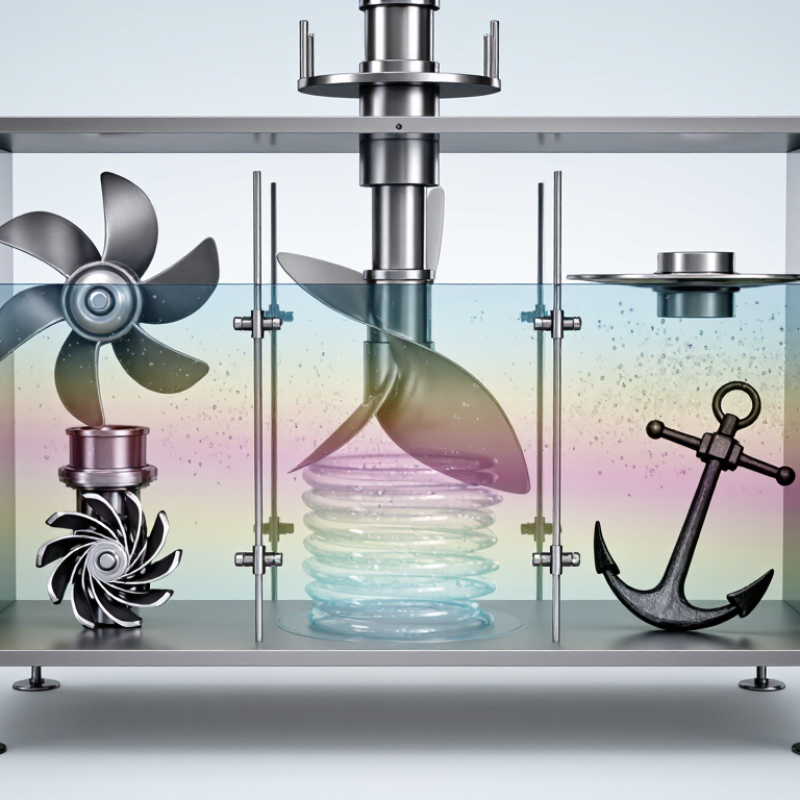
Agitators are mechanical devices that move liquids, slurries, or soft solids inside a vessel. Their purpose is practical: maintain uniform temperature, distribute ingredients, suspend particles, or improve contact between materials. A motor turns an impeller through a shaft, creating controlled circulation within the tank.
Different impellers create different flow patterns. Propeller designs produce strong axial movement, while turbine designs encourage radial circulation and gas dispersion. Paddle agitators move gently and suit blending tasks with lower shear. Anchor agitators scrape material near vessel walls and support viscous products. The choice depends on viscosity, tank geometry, solids content, and the required mixing time.
In real operation, selection is rarely perfect on paper. A thick fluid may need more torque than expected after cooling. A fast impeller can also introduce air, foam, or unwanted heat. I have found that observing the surface is useful, but it does not reveal everything below it. Check shaft stability, motor load, cleaning access, and the position of baffles. Small design details matter. Laboratory tests or pilot trials can expose dead zones before full-scale installation. A suitable agitator should deliver the required circulation without excessive energy, noise, or mechanical stress.
| Agitator Type | Primary Flow Pattern | Typical Uses | Suitable Material or Process | Typical Speed Range* | Main Advantages | Key Selection Considerations |
|---|---|---|---|---|---|---|
| Propeller Agitator | Primarily axial flow with strong circulation along the vessel axis | Low-viscosity blending Suspension Gas dispersion | Water-like liquids and fluids generally below approximately 2,000 mPa·s | Approximately 300–1,500 rpm | High circulation rate, compact design, and effective mixing at relatively low power | Check liquid viscosity, impeller diameter, vessel geometry, and the need for baffles |
| Pitched-Blade Turbine | Combination of axial and radial flow, depending on blade angle and configuration | General blending Solid suspension Heat transfer | Low- to medium-viscosity liquids with suspended solids | Approximately 100–600 rpm | Versatile performance and a balanced combination of circulation and shear | Choose blade angle and diameter according to solids concentration, settling behavior, and power demand |
| Flat-Blade Turbine | Strong radial flow with high local turbulence | Gas dispersion Liquid blending Reaction processes | Low- to medium-viscosity liquids where shear and turbulence are required | Approximately 100–800 rpm | Good gas dispersion and strong mixing intensity | Consider shear sensitivity, vortex control, power input, and the possibility of mechanical damage to fragile particles |
| Hydrofoil Impeller | High-efficiency axial flow with relatively low turbulence | Large-volume blending Solids suspension Flocculation | Low-viscosity fluids and processes requiring gentle, energy-efficient circulation | Approximately 50–400 rpm | Low power consumption, high pumping capacity, and reduced shear | Use baffles and adequate submergence; evaluate solids settling velocity and required turnover time |
| Anchor Agitator | Primarily tangential and wall-sweeping flow | Viscous blending Heat transfer Wall scraping | Medium- to high-viscosity fluids, often approximately 1,000–100,000 mPa·s | Approximately 5–100 rpm | Good wall coverage and improved heat transfer in jacketed vessels | Maintain suitable wall clearance; assess torque, vessel diameter, yield stress, and heating or cooling requirements |
| Helical-Ribbon Agitator | Strong axial and helical circulation with efficient movement through viscous material | High-viscosity blending Paste mixing Emulsions | Highly viscous liquids, pastes, creams, and non-Newtonian materials | Approximately 10–150 rpm | Effective bulk movement and good mixing in materials that do not flow easily | Requires accurate torque sizing; consider clearance, batch fill level, and whether a scraper is needed |
| Gate Agitator | Low-shear circumferential flow near the vessel wall | Gentle blending Heat transfer Settling prevention | Viscous, shear-sensitive, or heat-sensitive products | Approximately 5–80 rpm | Gentle operation and broad wall coverage with limited product damage | Evaluate viscosity changes during heating or cooling and the required drive torque at start-up |
| High-Shear Rotor–Stator | Localized radial flow with intense shear in a narrow rotor–stator gap | Emulsification Particle-size reduction Deagglomeration | Dispersions, emulsions, suspensions, and formulations requiring fine droplets or particles | Approximately 1,000–10,000 rpm | Rapid dispersion and high local energy density | Check temperature rise, air entrainment, product sensitivity, residence time, and cleaning requirements |
| Magnetic Agitator | Small-scale axial or radial circulation generated by a magnetically driven bar or impeller | Laboratory blending Closed processing Sterile applications | Low-viscosity liquids in small vessels where shaft penetration should be avoided | Approximately 100–2,000 rpm | No mechanical shaft seal, low contamination risk, and simple operation | Confirm vessel size, liquid viscosity, coupling strength, operating temperature, and maximum fill volume |
| Static Mixer | Internal fixed elements repeatedly divide, rotate, and recombine the flowing streams | Continuous blending Inline dosing Gas-liquid contact | Continuous-flow liquids, gases, and liquid–liquid streams with suitable flowability | Not applicable; performance depends on flow rate and pressure drop | No rotating drive, low maintenance, and compact continuous operation | Size for flow rate, viscosity ratio, mixing quality, pressure drop, fouling tendency, and cleanability |
