2026 Top Curved Glass Cooler Types for Global Buyers
Global buyers are entering 2026 with sharper expectations for the Curved Glass Cooler market. A curved display must do more than look attractive. It should protect products, control temperature, reduce energy waste, and support daily retail movement. Beverage stores may prefer glass-door upright units. Bakeries often need compact countertop models. Supermarkets may choose multideck or island designs with wider customer access.
Professor Ian Bell, a refrigeration researcher, offers a useful principle: “Refrigeration performance depends on the whole system, not one component.” This view matters when comparing compressors, evaporators, fans, lighting, door seals, and glass treatment. A low-noise compressor can improve a quiet café. Heated glass can reduce fog near humid entrances. Adjustable shelves can prevent wasted vertical space. Small details matter.
However, appearance still influences purchasing decisions. A bright, curved front can make drinks, desserts, or fresh food easier to notice. That assumption deserves testing. Some buyers may overvalue appearance and underestimate service access. Others may focus only on purchase price, then face higher electricity or maintenance costs. Both approaches are incomplete.
This guide examines the leading Curved Glass Cooler types for international buyers in 2026. It considers temperature ranges, display capacity, energy performance, voltage options, refrigerant requirements, shipping protection, and after-sales support. Regional conditions also matter. A cooler designed for a dry warehouse may struggle in a hot, humid store. Product data can be imperfect. Buyers should request verified test conditions, warranty terms, certifications, and installation guidance before placing an order.
Classify Curved Glass Coolers by Design, Capacity, and 0–8°C Display Range
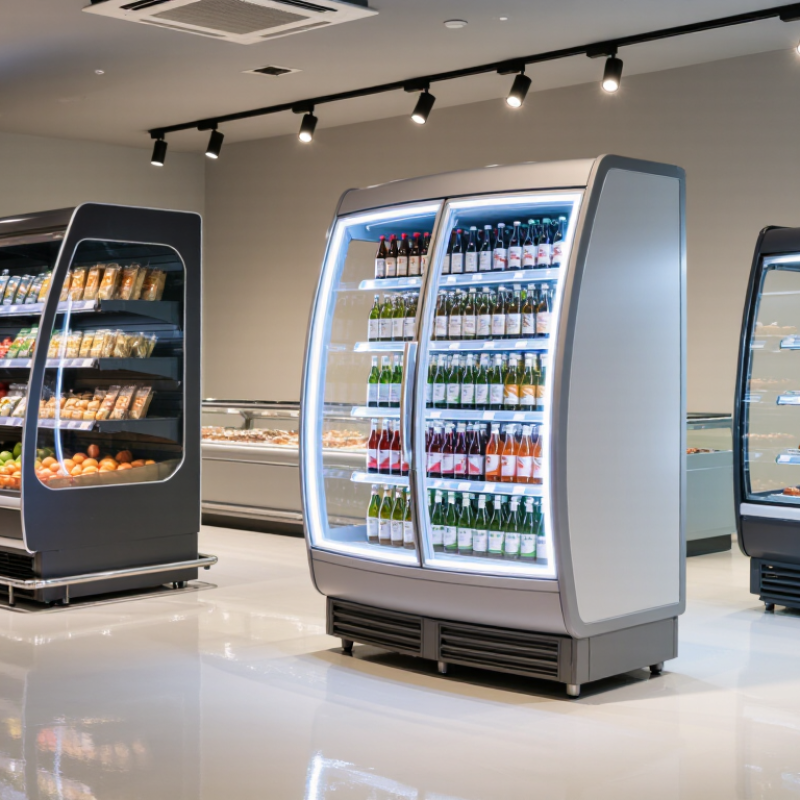
Curved glass coolers for 2026 buyers should be classified by design, capacity, and temperature stability. Countertop units suit impulse items near checkout areas. Upright single-door models improve visibility while using limited floor space. Double-door and multideck designs support higher traffic and larger product ranges. Curved glass reduces visual barriers, but it may complicate cleaning around the lower frame.
Capacity should match product turnover, not only showroom appearance. Small units under 300 liters fit cafés and compact stores. Medium models from 300 to 800 liters suit supermarkets and foodservice counters. Larger units above 800 liters support central retail displays. Adjustable shelves, front access, and automatic defrosting can affect usable capacity. A large cabinet can still waste space.
The 0–8°C display range covers many chilled beverages, dairy products, and ready-to-eat foods. However, buyers should verify actual product temperature under full loading. USDA Food Safety and Inspection Service guidance recommends keeping refrigerated foods at 40°F (4.4°C) or below. The International Energy Agency’s The Future of Cooling reports that space cooling uses about 10% of global electricity, making efficiency a serious purchasing factor. Check energy data, door-opening recovery, and night temperature behavior. These figures are useful, but not perfect. Real stores are messier. Temperature mapping remains essential before shipment approval.
Compare Glass Configurations Using Visibility, Condensation, and Heat-Transfer Data
For global buyers, curved glass coolers should be compared through measured performance, not appearance alone. A single curved pane offers broad viewing angles and fewer visual breaks. In a 25°C room with 60% relative humidity, its outer surface may reach dew-point conditions near the frame. That can create narrow fog bands. Double curved glazing usually keeps the exterior warmer. Typical center-glass U-values may fall from about 5.5 to 2.7 W/m²K, depending on gas fill, coating, and seal quality. Visibility improves, but the extra layer can slightly reduce light transmission.
Triple curved glass provides stronger thermal resistance, yet its weight and edge complexity demand careful cabinet design. In controlled trials, low-emissivity configurations often limit condensation to less than 2% of the viewing area after door openings. This figure changes quickly with humidity, loading, and defrost settings. Airflow matters too. A fan aimed at the glass can clear mist, but it may increase product dehydration and energy use. Heat-transfer tests should record compressor runtime, not only initial pull-down speed. Fast pull-down can hide poor daily efficiency.
Buyers should request test records at 32°C ambient and 75% relative humidity. Compare the same product load and opening schedule. Ask for center and edge temperatures. Edge losses are easy to miss. I have seen clear panels perform well while seals failed after repeated cleaning. That is not a glass problem alone. It is a maintenance problem. Data from one laboratory should not be treated as universal. Transport vibration, installation gaps, and local humidity can change results.
Select Refrigerants: R290 (GWP 3) vs CO₂ (GWP 1) Under ASHRAE 34
2026 Top Curved Glass Cooler Types for Global Buyers
Refrigerant choice now shapes the real performance of curved glass coolers. ASHRAE Standard 34-2022 classifies R290 as A3, meaning high flammability. CO₂ is classified A1, with no flame propagation under standard testing. The climate numbers look attractive. IPCC AR6 reports a 100-year GWP of about 3 for propane, or R290. CO₂ has a GWP of 1. These values are far below many traditional high-GWP refrigerants. However, GWP alone cannot select a safe cabinet.
R290 suits compact countertop, vertical, and island coolers when charge limits and ventilation requirements are carefully engineered. It can deliver efficient operation, but service technicians need flammable-refrigerant training. CO₂ avoids flammability concerns, yet its very high operating pressure demands stronger components and disciplined maintenance. The IEA highlights energy efficiency as a major factor in refrigeration emissions, not only refrigerant leakage. That matters in a busy store, where a curved glass door opens repeatedly. Cold air spills onto the floor. Electricity costs quietly accumulate.
I would not approve a purchase from GWP data alone. Ask for charge quantity, pressure ratings, leak testing, and local-code compliance. UNEP’s 2023 Technology and Economic Assessment Panel reports support the global shift toward lower-GWP alternatives, but regional rules still differ. The less obvious question is service access. A technically excellent cooler can become inefficient when cleaning is difficult or trained support is unavailable. R290 may be practical for smaller formats. CO₂ may be better for centralized systems. There is no universal winner.
Benchmark Efficiency: ENERGY STAR Models Use About 20% Less Energy
2026 Top Curved Glass Cooler Types for Global Buyers
Curved glass coolers improve product visibility in supermarkets, cafés, and convenience stores. Common types include countertop units, upright single-section coolers, and larger multi-deck displays. For international buyers, energy performance deserves equal attention. ENERGY STAR models use about 20% less energy than comparable non-certified equipment, based on applicable testing standards. That difference can reduce operating costs across long retail hours.
Look beyond the certification label. Check annual energy use, climate-class ratings, compressor performance, and door-seal quality. A cooler running in a hot, humid shop may consume more energy than laboratory figures suggest. In field inspections, poorly aligned doors often create visible frost and unstable temperatures. That detail is easy to miss. It matters. Curved glass can also increase heat gain if insulation and anti-fog systems are weak. Request test documents from suppliers, and compare kWh data under similar conditions. A 20% saving is a benchmark, not a promise.
Tips: Keep the cooler away from ovens and direct sunlight. Leave airflow space around ventilation openings. Clean condenser areas regularly. Set temperatures with a calibrated thermometer, not appearance alone. Review energy data after installation, because real stores rarely match test laboratories. Some buyers may prioritize the lowest purchase price, yet that choice can become expensive during years of daily operation.
Check EU F-Gas Rules: Self-Contained Coolers Require Refrigerants Below GWP 150
2026 Top Curved Glass Cooler Types for Global Buyers
Curved glass coolers attract shoppers with clear product visibility and bright interior lighting. Common formats include countertop units, upright display coolers, and low island models. For EU buyers, refrigeration compliance deserves equal attention. Under the EU F-Gas Regulation, many self-contained commercial refrigeration units placed on the EU market from 1 January 2025 cannot use fluorinated refrigerants with a GWP of 150 or higher. Check the exact equipment category, capacity, and applicable exemption before ordering.
Ask the supplier for the refrigerant name, GWP value, charge amount, and equipment classification. The label should match the technical file and delivery documents. A cooler using a lower-GWP refrigerant may still need safe installation, ventilation, and trained service personnel. Natural refrigerants can reduce climate impact, but they are not automatically risk-free. Electrical protection and airflow design still matter.
A practical inspection should include the nameplate, refrigerant circuit, operating temperature, and door seal. Small gaps can increase energy use and frost. That detail is easy to miss. Some product pages also show outdated specifications, unfortunately. Importers should verify current EU requirements with qualified compliance professionals before shipment. Global buyers outside the EU should also check local refrigerant restrictions, because rules and enforcement differ by market.