
If you are interested in financing to fund your Bay-Lynx purchase, we recommend that you connect with Easylease Corp., a Canadian-based leasing and finance company that offers premier equipment leasing and financial services. They are focused on making it easier than ever before for companies to overcome cash flow and resource constraints to acquire the assets they need to grow their business.
Leasing through Easylease Corp. can offer several benefits:
Click here for your Canadian instant lease quote >>
For US customers, Click here for your instant lease application >>
Glass shelves make a room feel open, but the brackets supporting them do serious work. A poorly matched fitting can look awkward, complicate installation, or leave a shelf feeling less secure. Choosing a reliable Glass Shelf Brackets Supplier therefore means looking beyond attractive product photos. Details matter.
This guide introduces 10 suppliers serving customers in different regions and project markets. It highlights practical factors such as bracket materials, finishes, glass compatibility, mounting options, and available product information. These points help buyers compare suppliers for bathroom shelves, retail displays, office interiors, and other applications. A bright chrome finish may suit one space, while brushed stainless steel may better match another. Wall type and shelf dimensions also influence the choice.
Good specifications help. So does clear communication. Still, a polished catalog cannot answer every question. Buyers may need to confirm dimensions, load guidance, installation hardware, or customization directly with a supplier. Product quality can vary between models, even within one catalog, so careful review is worthwhile. The companies featured here offer different strengths, but no single supplier will suit every project. Use this overview as a starting point, then verify current product details and service terms before making a decision.
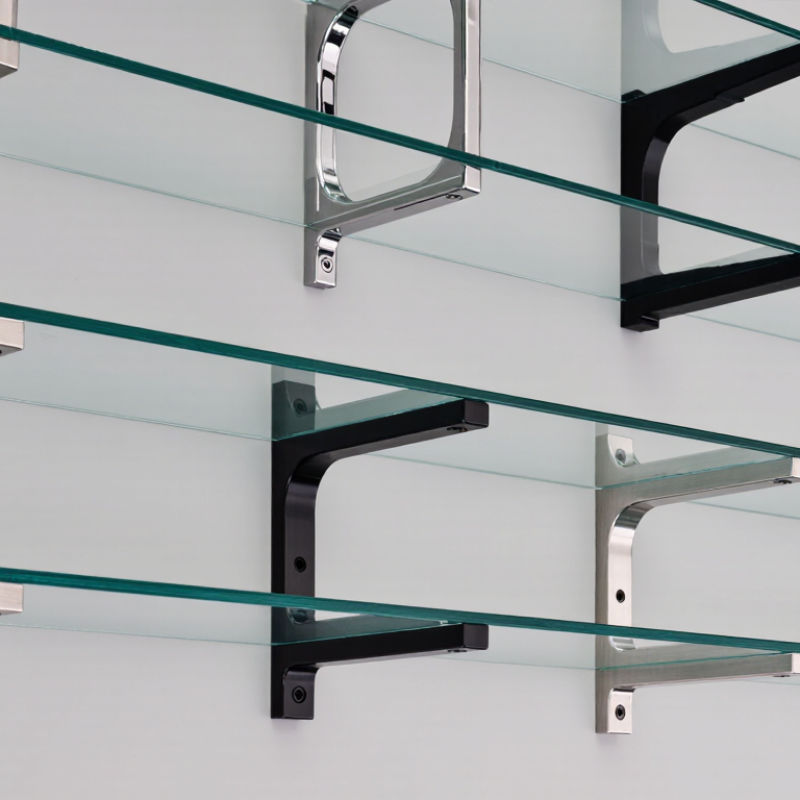
Glass shelf brackets are load-bearing fittings designed to support glass panels against a wall or cabinet. They usually combine a wall plate, fixing screws, and a gripping pad or clamp. The pad helps distribute pressure across the glass edge. Without it, a small point load can create a dangerous crack.
Most systems work through clamping force and friction. The bracket holds the shelf between soft liners, while the wall anchors carry the transferred weight. Tempered glass is widely preferred because it offers stronger impact resistance than ordinary annealed glass. However, it can still fail after edge damage. The International Energy Agency reports that buildings account for about 30% of global energy demand, encouraging more efficient glass use in modern interiors. That trend increases interest in glass shelving, but appearance should never replace load testing.
Tips: Check the glass thickness before ordering. Match each anchor to the wall material, not just the bracket size. Keep brackets evenly spaced, with support near the shelf ends. Never tighten clamps until the glass bows. That mistake is easy to make. Ask suppliers for tested load ratings, installation diagrams, and material specifications. ASTM safety-glazing guidance is also worth reviewing, although it does not replace a qualified installer’s judgment. Research from Grand View Research estimates the global flat glass market will continue expanding through 2030, yet bracket quality remains highly dependent on installation details. A beautiful shelf can still be poorly supported.
Global supplier evaluation starts with load evidence, not polished product photos. Bracket selection depends on glass thickness, shelf depth, wall substrate, and expected impact. Ask suppliers for tested load ratings, test methods, and safety margins. A rating without test conditions means little. Confirm whether testing covers tempered or laminated glass. Inspect edge protection, including silicone pads and rounded contact surfaces. Small omissions can become visible cracks.
Reliable suppliers provide technical drawings, tolerance ranges, installation manuals, and physical samples. Their instructions should explain torque, anchor types, hole spacing, and glass clearance. Sales and technical teams should give consistent answers. Review batch identification, inspection records, material grades, and surface treatment details. Stainless steel alone proves little. Corrosion resistance and machining quality matter in humid rooms. Ask whether replacement pads, screws, or covers remain available after delivery.
Compare lead times, packaging quality, production capacity, and communication speed. Request photos of packed cartons, not only finished displays. Independent test reports can strengthen confidence, but vague certificates deserve careful questions. Regional installation requirements may also differ. A low quote might hide thin pads, uneven finishing, or inconsistent fasteners. No evaluation is perfect. I would keep a written scorecard and record every unanswered question. That small discipline can expose weaknesses before dozens of glass shelves reach a project site.
The global glass market is projected to grow at about 6% annually through 2030, according to Grand View Research’s 2024 industry outlook. This expansion supports demand for compact, reliable shelf hardware. A 2023 report from Mordor Intelligence also identifies renovation and commercial interiors as important growth drivers. Brackets now need more than attractive finishes. Load capacity, corrosion resistance, glass protection, and installation accuracy matter.
Supplier One focuses on stainless steel brackets for humid bathrooms. Supplier Two serves retail displays with adjustable supports. Supplier Three produces concealed systems for minimalist interiors. Supplier Four offers heavy-duty fittings for hospitality projects. Supplier Five specializes in small-batch architectural hardware. Supplier Six supplies powder-coated brackets for residential renovations. Supplier Seven combines tempered glass accessories with matching supports. Supplier Eight targets distributors needing consistent stock across regions. Supplier Nine develops custom shapes for designers and contractors. Supplier Ten provides budget-oriented fittings for standard shelf sizes.
These profiles reveal different strengths, not identical quality. ISO 9227 salt-spray testing can help assess corrosion performance, although test results may not reflect every installation environment. Suppliers should provide verified load data, glass thickness ranges, fastener specifications, and installation drawings. A bracket rated for 40 kilograms may perform differently on uneven walls. That detail is often overlooked. I would also request samples before approving a large order. A polished finish can hide weak threads, poor alignment, or sharp contact points. Product pages are useful, but independent testing and practical fitting experience remain more convincing.
Anonymous supplier capability profiles. The entries below describe verifiable product and sourcing criteria, not claims about specific companies. Product dimensions and load ratings vary by design; confirm them with the supplier for each project.
| Profile | Supplier capability | Bracket and glass details to confirm | Relevant material or test reference | Buyer verification point |
|---|---|---|---|---|
| 01 | Stainless-steel clamp bracket specialist | Confirm supported glass thickness, clamp dimensions, pad material, and whether drilling is required. | AISI 304 and 316 stainless steels are commonly specified for corrosion-resistant hardware; verify the stated grade and finish. | Request material documentation and installation instructions for the exact model. |
| 02 | Brass architectural-hardware supplier | Check body material, coating type, finish options, and compatibility with the specified glass edge. | Coating appearance and corrosion performance depend on the coating system and test conditions. | Ask for finish samples and written cleaning and maintenance guidance. |
| 03 | Aluminium extrusion bracket manufacturer | Confirm alloy, wall thickness, profile dimensions, mounting method, and intended indoor or outdoor use. | Anodizing is a surface treatment for aluminium; coating thickness and performance should be specified for the application. | Request a dimensioned drawing and finish specification. |
| 04 | Zinc-alloy die-cast hardware supplier | Check the alloy designation, casting quality controls, mounting hardware, and maximum recommended service environment. | The corrosion resistance of finished zinc-alloy parts depends on the alloy and protective finish. | Request finish specifications and evidence that the bracket has been tested for its intended use. |
| 05 | Custom-fabricated bracket supplier | Confirm drawing approval, tolerances, edge clearances, hole positions, and prototype process. | For heat-treated flat glass, ASTM C1048 covers heat-strengthened and fully tempered glass products. | Coordinate bracket geometry with the glass fabricator before production. |
| 06 | Concealed-support system supplier | Check wall substrate requirements, anchor type, support spacing, and whether the design suits the shelf depth. | There is no single universal load rating for glass shelf brackets; capacity depends on the complete installation. | Obtain a tested load rating with the stated substrate, fixing method, spacing, and safety conditions. |
| 07 | Adjustable or multi-thickness clamp supplier | Verify the actual clamping range, adjustment mechanism, pad replacement options, and prevention of glass-to-metal contact. | Glass thickness compatibility is model-specific and should be confirmed against the product drawing. | Request the permitted glass-thickness range and installation torque, if applicable. |
| 08 | Wet-area hardware supplier | Confirm suitability for humid environments, drainage or water-trapping details, and compatible cleaning products. | ISO 9227 specifies salt-spray corrosion tests; it does not by itself establish a universal service-life rating. | Review the test method, duration, acceptance criteria, and relevance to the intended environment. |
| 09 | High-volume standard-hardware supplier | Check catalogue consistency, packaging, spare-part availability, production lead time, and order minimums. | A stated quality-management certification should be checked for scope, issuing body, and validity. | Request current certificates and a sample from the production specification being quoted. |
| 10 | Project-supply and sourcing partner | Confirm traceability, inspection plan, export packaging, documentation, and responsibility for specification changes. | A supplier’s declared load capacity should identify the test configuration and whether the value applies per bracket or per pair. | Compare written specifications and test reports rather than relying on an unqualified capacity figure. |
Choosing among the 10 best glass shelf bracket suppliers requires more than comparing prices. Product consistency matters. Grand View Research valued the global glass market at approximately USD 166.7 billion in 2023, reflecting strong demand across construction and interiors. That scale increases supplier choice, but it also creates uneven quality.
Material selection should match the shelf and environment. Stainless steel offers corrosion resistance for bathrooms and coastal homes. Aluminum is lighter, but may feel less substantial under heavy loads. Zinc alloy supports attractive finishes, although its strength varies by grade. Suppliers should provide load ratings, alloy specifications, coating details, and test evidence. ASTM guidance on glass and hardware performance is useful, yet supplier documentation remains critical. Small details matter.
Customization separates a basic bracket from a reliable installation system. Check hole spacing, glass thickness compatibility, edge clearance, finish samples, and adjustable angles. A 2024 construction materials outlook from Fortune Business Insights identifies renovation and commercial interiors as continuing demand drivers, where consistent replacement parts can reduce installation delays. I would still question every impressive catalog claim. Some ratings assume perfect walls, balanced loading, and professional installation. Real projects are rarely that neat. Ask for sample units, dimensional drawings, salt-spray results, and packaging tests before placing a volume order. Suppliers offering low minimum quantities can also help validate fit without creating expensive stock problems.
Matching a glass shelf bracket supplier starts with your project conditions, not a global ranking. Measure the glass thickness, shelf depth, wall type, and expected load. A bathroom shelf near steam needs corrosion-resistant hardware and stable finishes. A retail display may require higher load ratings and frequent cleaning. Fit matters.
Ask each supplier for material specifications, load-test results, installation drawings, and quality-control records. Check whether brackets suit tempered or laminated glass without unsafe drilling. Reliable suppliers should explain tolerances, packaging methods, replacement policies, and production lead times. Request samples before approving a large order. A sample can reveal sharp edges, loose screws, uneven plating, or poor protective packaging.
Compare communication quality as carefully as price. Clear answers often indicate stronger technical support. Confirm whether the supplier can provide consistent dimensions across repeat orders. For international projects, review shipping terms, labeling, inspection procedures, and documentation requirements. Details matter. A common project lesson is that attractive hardware may fail when the wall anchors are unsuitable. Ask for fixing guidance based on concrete, tile, drywall, or timber. No supplier is perfect. Record every assumption, then challenge it before installation, because a small mismatch can delay an entire interior project.
Use this weighted screening model to compare suppliers without relying only on price. Confirm glass compatibility, tested load capacity, corrosion resistance, lead time, and customization capability before placing an order.
The percentages represent a practical project-screening framework rather than market-share data. Final supplier selection should be based on the project’s glass thickness, shelf dimensions, mounting surface, safety requirements, finish, quantity, and delivery location.